

An extra heavy duty caster contains two separate bearing systems that perform different jobs. Wheel bearings sit inside the wheel hub and allow the wheel to rotate around its horizontal axle. Swivel bearings sit between the mounting plate and fork and allow a swivel caster to change direction around a vertical axis.
Confusing these systems can lead to the wrong diagnosis or specification. A caster may roll poorly because its wheel bearings are damaged, yet its swivel head can still turn normally. Another caster may roll freely in a straight line but resist steering because the swivel-bearing structure is worn, contaminated or overloaded.
Bearing construction also helps explain why two casters with similar wheel diameters and materials can have very different capacities. BigCaster can increase the wheel-bearing quantity in selected E-series products from two to four bearings per wheel. In its extra heavy duty swivel designs, BigCaster combines an upper ball-bearing structure with a lower flat tapered bearing instead of relying only on conventional upper and lower loose-ball races. These changes provide a stronger foundation for high load support, stable rotation and impact resistance.
However, bearing type and quantity do not determine caster capacity alone. The wheel core, hub, axle, fork, swivel structure, top plate, fasteners and equipment frame must all carry the same load safely. This guide explains how the two bearing systems work, how to compare their construction and what to specify for an industrial application.
If you are already comparing products, browse BigCaster’s extra heavy duty casters. If the required caster class is still uncertain, begin with Heavy Duty Casters vs Extra Heavy Duty Casters.
Quick Answer: What Bearings Are Used in a Heavy Duty Caster?
The term heavy duty caster bearings can refer to either bearings inside the wheel or bearings inside the swivel head. These components should be identified separately.
| Bearing system | Location | Motion it supports | Common construction | Extra heavy duty direction |
|---|---|---|---|---|
| Wheel bearings | Inside the wheel hub around the axle | Wheel rotation around a horizontal axis | Plain bearing, roller bearing or precision ball bearings | Larger bearings, stronger hub support or additional bearing pairs |
| Conventional swivel bearing | Between top plate and fork | Fork rotation around a vertical axis | Upper and lower groups of hardened steel balls | Larger raceways, stronger rolling elements and reinforced swivel structure |
| BigCaster extra heavy duty swivel bearing | Between top plate and fork | Loaded steering and swivel rotation | Upper ball-bearing structure plus lower flat tapered bearing | Improved high-load support and impact resistance |
| BigCaster E-series wheel bearing system | Inside single or dual wheel hubs | Loaded wheel rotation | Two or four precision ball bearings per wheel, depending on design | Four bearings can distribute hub support across more bearing positions |
Two wheel bearings are commonly installed with one bearing near each side of the hub. In a four-bearing wheel, additional bearings increase the number of rolling-element support positions within the hub. In a dual-wheel caster using four bearings per wheel, the complete caster contains eight wheel bearings.
The swivel bearing system is different. It carries load between the mounting plate and fork while allowing the whole fork-and-wheel assembly to change direction. A rigid caster has wheel bearings but does not have a swivel-bearing structure.
A Caster Has Two Different Axes of Rotation
The easiest way to understand the two bearing systems is to identify their axes.
Horizontal wheel axis
The wheel rotates around the axle. Bearings pressed or installed inside the wheel hub reduce friction between the rotating wheel and the relatively stationary axle or inner bearing races.
This motion determines how easily the caster rolls forward or backward. Wheel-bearing condition affects:
- Starting force
- Continuous rolling resistance
- Wheel alignment
- Hub play
- Axle and bearing temperature
- Noise and vibration
- Wheel service life
Vertical swivel axis
On a swivel caster, the fork rotates beneath the mounting plate. The swivel-bearing system guides this movement while transferring load from the equipment into the fork.
This motion determines how easily the caster changes direction. Swivel-bearing condition affects:
- Steering force
- Swivel alignment
- Direction changes
- Swivel play
- Fork stability
- Response to side force and impact
- Swivel-head service life
These axes interact during a turn, but they are not mechanically identical. A product drawing, inspection report or purchasing specification should state which bearing system it describes.
Part 1: Wheel Bearings Inside the Caster Wheel
A caster wheel bearing sits between the wheel hub and axle. Its job is to support the wheel while allowing it to rotate with controlled friction and alignment.
The vertical equipment load travels through the caster fork and axle into the wheel bearings, then through the hub and wheel material to the floor. When the caster crosses a floor joint or turns under load, the bearing system may also experience shock, side force and temporary misalignment.
What loads act on caster wheel bearings?
Radial load
The main vertical load on a wheel produces a radial force relative to the axle. The bearing, inner and outer races, axle and hub must transfer this load without excessive deformation or contact stress.
Axial and side load
Wheel bearings are not always loaded only in a perfectly radial direction. Swiveling, wheel scrub, side pushing, frame misalignment and a deflecting axle can introduce side forces. The magnitude depends on the caster layout, tread material, floor friction and movement.
Impact load
When a loaded wheel strikes an expansion joint, threshold, gap or piece of debris, the load is no longer purely static. The impact travels through the tread, wheel core, hub, bearings, axle and fork. Larger wheels and resilient treads may reduce the severity of some obstacles, but they do not eliminate impact.
Cyclic load
A bearing in a frequently moving caster experiences repeated stress cycles. Travel distance, speed, load, lubrication and contamination all influence fatigue and wear.
Misalignment and axle deflection
An overloaded or insufficiently supported axle can bend. A flexible fork or poorly machined hub can also change bearing alignment. Even a high-quality bearing can perform poorly when its surrounding structure does not hold it correctly.
Common Caster Wheel Bearing Types
Different bearing types suit different load, speed, maintenance and environmental requirements. The name of the bearing alone is not enough; size, material, clearance, seals, fit and installation also matter.
Plain or sleeve bearings
A plain bearing allows sliding motion between the wheel hub and axle or bushing. It may be made from metal, polymer or a composite material.
Typical advantages include:
- Simple construction
- Low component cost
- Few moving elements
- Possible suitability for dirty, wet or corrosive conditions when the material is properly selected
Trade-offs can include:
- Higher friction than a suitable rolling-element bearing
- More sensitivity to shaft finish and clearance
- Less efficient movement under very high loads
- Wear that increases hub play
Plain bearings can be appropriate for slow or infrequently moved equipment, but they are rarely the first choice when a very heavy manual cart requires low rolling resistance.
Roller and needle bearings
Roller bearings use cylindrical or needle-shaped rolling elements. Their line-contact geometry can support substantial radial load within a compact arrangement.
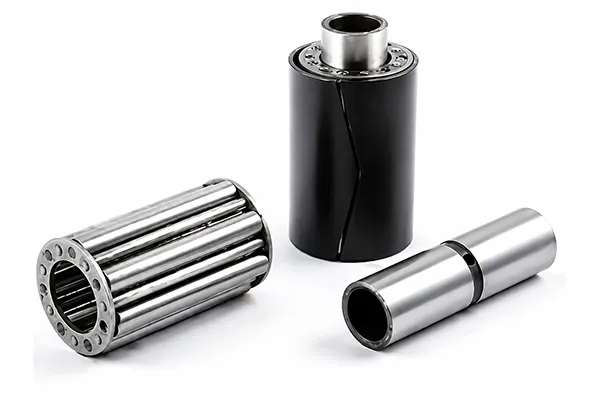
Their performance depends on:
- Bearing length and diameter
- Axle hardness and surface finish
- Inner and outer race construction
- Lubrication
- End-thrust control
- Contamination protection
Roller bearings can be useful in industrial caster wheels, but a roller-bearing label does not by itself establish the complete caster rating or suitability for powered travel.
Precision ball bearings
Precision ball bearings use hardened balls running between inner and outer raceways. They are common in technically demanding industrial and heavy duty caster wheels because they can provide precise rotation, low bearing clearance and efficient rolling when properly selected.
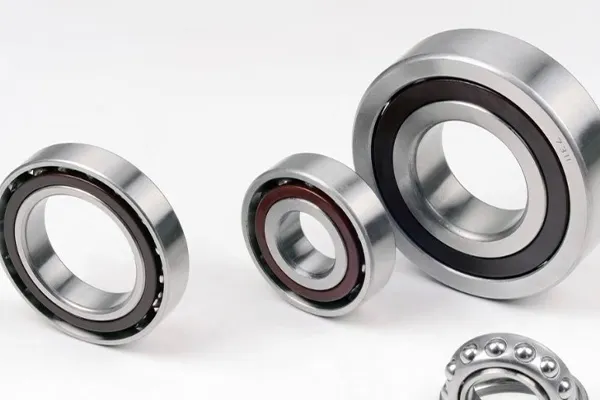
Important variables include:
- Bearing series and size
- Static and dynamic rating
- Internal clearance
- Shielded or sealed construction
- Grease specification
- Temperature range
- Corrosion resistance
- Fit in the wheel hub
- Support of the inner races and spacer
Two precision ball bearings—one near each side of the wheel hub—are a common arrangement. BigCaster also uses four ball bearings per wheel in selected extra heavy duty E-series designs.
Tapered roller bearings in caster wheels
Tapered roller bearings use tapered rollers and angled raceways. This geometry can support a combination of radial and axial load in a designed direction. Paired arrangements can support load from both axial directions.
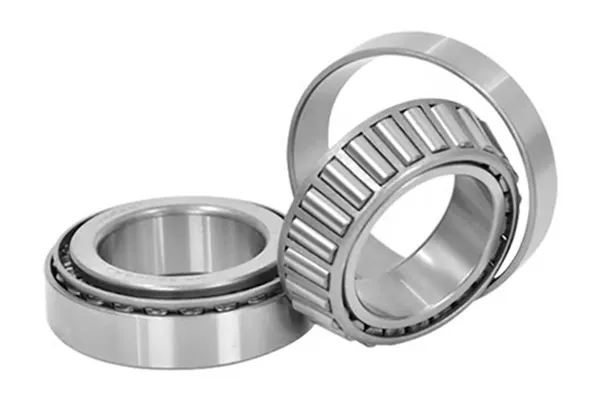
They are used in some high-capacity wheels, but they require correct installation and adjustment. Excessive preload can increase heat and resistance, while insufficient control can create play. A tapered roller wheel bearing should therefore be selected as part of the axle, hub, spacer and fork assembly.
Terminology note: A tapered roller bearing used inside a wheel hub is not automatically the same component as the lower flat tapered bearing used in BigCaster’s extra heavy duty swivel structure. One supports wheel rotation around the axle; the other supports rotation and load transfer in the swivel head.
Spherical roller bearings
Spherical roller bearings use two rows of barrel-shaped rollers and can tolerate some angular misalignment while supporting very high radial loads. They can be used in specialized heavy duty wheels where capacity, continuous industrial service and shaft deflection are important.
Their size, cost, sealing and lubrication requirements may be unnecessary for other applications. They should not be specified only because their nominal bearing rating is high.
Why Most Caster Wheels Use Two Bearings
Placing one bearing near each side of a wheel hub creates two separated support points along the axle. This arrangement helps:
- Transfer load from both sides of the hub
- Keep the wheel aligned on the axle
- Limit wheel tilt
- Support the hub against side force
- Maintain a controlled distance between bearing races
- Reduce unsupported hub length
Two bearings do not necessarily carry exactly half the load each. Actual distribution depends on bearing fit, hub rigidity, spacer dimensions, axle deflection, fork alignment and side loading.
The role of the spacer and inner-race support
Many ball-bearing wheel assemblies use a spacer between the inner bearing races. When the axle is tightened, the spacer allows the inner races to be clamped without forcing an unintended axial load through the balls.
If the spacer is too short, damaged or missing, tightening the axle may create excessive bearing preload. If the spacer is too long or the bearing seats are incorrect, the wheel may have side play. This illustrates why the bearing model alone cannot describe the whole assembly.
Bearing fit in the hub
The outer bearing race must be supported by the wheel hub with an appropriate fit. A loose fit can allow movement and wear in the bearing seat. An excessively tight or distorted fit can change internal clearance. Wheel-core material, machining accuracy and operating temperature all influence this interface.
Why BigCaster Can Increase Wheel Bearings From Two to Four
For selected E-series extra heavy duty caster wheels, BigCaster can increase the wheel-bearing quantity from two to four. Instead of using only one bearing near each side of the hub, the wheel can use additional bearing support within the available hub width.
This design direction can provide:
- More rolling-element bearing capacity within the hub assembly
- Additional support points along the axle
- Better distribution of load through the wheel hub
- Reduced demand on each individual bearing when load sharing is properly designed
- Greater resistance to wheel tilt under high load
- A stronger foundation for a higher complete-wheel rating
- Increased robustness for demanding industrial service
The benefit is especially relevant when a wide wheel or high-capacity wheel core provides enough hub space for multiple bearings and appropriate spacers.
Four bearings do not automatically double capacity
Changing from two bearings to four does not mean the complete caster can automatically carry twice the load. The final rated capacity still depends on:
- Bearing size, series and rating
- Whether the bearings share load as intended
- Wheel-core material and hub thickness
- Hub length and bearing-seat accuracy
- Axle diameter, material and support span
- Spacer and inner-race clamping
- Fork strength and alignment
- Swivel-bearing capacity
- Top plate and mounting strength
- Wheel material, diameter and width
- Speed, shock, floor and duty cycle
- Validation and rating conditions
The extra bearings remove or raise only one possible limit. If the axle, wheel core or swivel structure becomes the weakest component, adding more wheel bearings will not solve that constraint.
BigCaster E-Series Wheel Bearing Examples
BigCaster E-series products show how bearing quantity can be matched to single-wheel, dual-wheel and very high-capacity constructions.
| BigCaster series | Wheel construction | Wheel-bearing specification | Bearing quantity | Published load range per complete caster |
|---|---|---|---|---|
| E0601 | Single MC nylon wheel | 6205 × 4 | Four wheel bearings | 2,000–3,000 kg |
| E0901 | Dual polyurethane wheels with iron cores | 6205 × 8 | Four per wheel; eight per complete caster | 3,000–5,000 kg |
| E0301 | Dual forged-steel wheels | 6305 × 8 | Four per wheel; eight per complete caster | 6,000–7,300 kg |
These model numbers identify the bearing products used in the published configurations. The full bearing specification—including manufacturer, clearance, seal, grease and exact fit—should be confirmed for replacement or OEM production rather than inferred only from the number.
E0601: four bearings in a single MC nylon wheel
The E0601 Extra Heavy Duty MC Nylon Caster uses a single 75 mm-wide MC nylon wheel with four 6205 ball bearings. Depending on wheel diameter, the published load capacity ranges from 2,000 to 3,000 kg per complete caster.
This configuration illustrates that “single wheel” does not mean “one bearing.” A wide single wheel can contain multiple bearing positions when the hub, axle and surrounding structure are designed for them.
E0901: eight bearings across two polyurethane wheels
The E0901 Super Heavy Duty Dual-Wheel Polyurethane Caster uses two polyurethane-on-iron-core wheels. Its data table specifies eight 6205 ball bearings in the complete dual-wheel caster—four bearings in each wheel. Published capacity ranges from 3,000 to 5,000 kg per caster, depending on size.
The iron wheel cores, polyurethane treads, dual-wheel geometry, bearings, axle and swivel structure all contribute to this capacity. The eight-bearing count should not be presented as the sole reason for the rating.
E0301: eight bearings in a dual forged-steel caster
The E0301 Super Heavy Duty Dual-Wheel Steel Caster uses two 45# forged-steel wheels, each fitted with four 6305 ball bearings. The complete caster therefore uses eight wheel bearings. Its published load range is 6,000–7,300 kg per caster.
E0301 also combines the high-capacity wheel construction with a flat tapered bearing in the swivel mechanism, reinforced bracket construction and a heavy mounting plate. This is a good example of the system principle: higher capacity comes from coordinated wheel, bearing, axle, fork, swivel and mounting design.
For the full calculation process, see the Extra Heavy Duty Caster Load Capacity Guide or use the caster wheel load capacity calculator for preliminary screening.
Part 2: Bearings Inside the Caster Swivel Structure
A swivel caster bearing sits in the rotating structure between the caster mounting plate and fork. It does not make the wheel roll around its axle. Instead, it allows the complete fork, axle and wheel assembly to rotate beneath the equipment.
The swivel head must perform two jobs simultaneously:
- Transfer equipment load from the mounting plate into the fork.
- Allow controlled rotation under that load.
This makes the swivel-bearing system a critical part of an extra heavy duty caster. Increasing wheel-bearing capacity cannot compensate for an undersized swivel structure.
How a Conventional Double-Ball-Race Swivel Works
Many conventional heavy duty swivel casters use two groups of hardened steel balls:
- An upper ball race
- A lower ball race
The balls roll between formed or machined raceway surfaces as the fork turns around the vertical swivel axis. A kingpin, rivet, bolt or other central retaining structure may hold the swivel assembly together, depending on the caster design.
Upper ball race
The upper ball race helps guide the rotating components and maintain alignment between the mounting plate and fork. It participates in load transfer and helps control swivel play.
Lower ball race
The lower ball race provides a second rolling support below the upper race. The separation between the upper and lower bearing groups helps the swivel head resist vertical load, side force and the moment produced by the offset between the swivel axis and wheel axle.
Why use two ball races?
Two separated ball races provide more stable support than one small row of balls. The arrangement is compact, economical and widely used. Its actual capacity depends on ball size and quantity, raceway diameter, raceway hardness, plate thickness, forming or machining quality, grease, seals and the central retaining structure.
Loose-ball raceways can be effective for ordinary heavy duty service, but very high vertical and impact loads can demand a more load-oriented lower bearing construction.
What Loads Act on a Swivel-Bearing System?
Vertical thrust load
Equipment weight passes down through the mounting plate and swivel head. The bearing system must support this vertical thrust while remaining able to rotate.
Radial and side load
When equipment is pushed sideways, changes direction or experiences wheel scrub, lateral forces enter the swivel head. A tow bar, off-center push handle or offset center of gravity can also add side demand.
Moment load from swivel offset
The wheel axle normally trails behind the vertical swivel axis. This horizontal distance is called swivel offset or swivel lead. Because the floor force acts at a distance from the swivel axis, it produces a moment in the swivel head.
This geometry helps the caster align with travel, but it also means the swivel-bearing system is not loaded by vertical weight alone.
Impact and shock load
A wheel striking an obstacle transmits a rapid force through the wheel bearings, axle and fork into the swivel structure. The severity depends on load, speed, wheel diameter, tread, obstacle geometry and frame response.
Repeated steering cycles
Every direction change moves rolling elements across the bearing raceways. Under heavy load, inadequate lubrication, contamination or surface damage can increase steering resistance and accelerate wear.
Why BigCaster Uses an Upper Ball Bearing and Lower Flat Tapered Bearing
In BigCaster’s extra heavy duty swivel designs, the conventional lower loose-ball race can be replaced by a lower flat tapered bearing, while an upper ball-bearing structure guides the swivel motion.
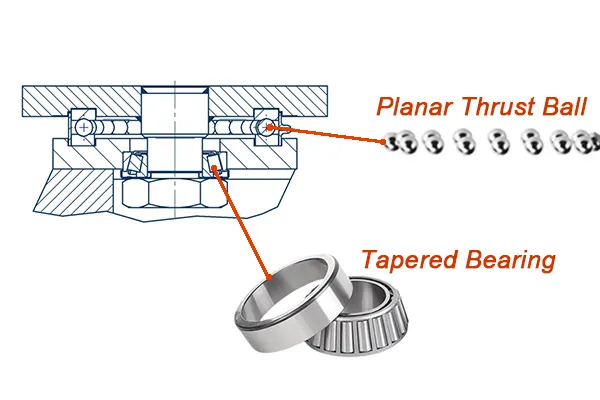
The two elements have complementary roles:
- The upper ball-bearing structure helps maintain smooth rotation and alignment.
- The lower flat tapered bearing provides a more load-oriented rolling contact structure in the heavily loaded lower part of the swivel head.
Compared with relying only on upper and lower steel-ball groups, this combination can improve:
- Vertical load support
- Distribution of load across the lower swivel structure
- Resistance to side force and overturning moment
- Stability of the fork under concentrated load
- Resistance to shock transmitted from the wheel
- Durability in demanding low-speed industrial service
The design does not make the swivel head immune to impact, and it does not remove the need for an adequately sized top plate, fork, axle and wheel. It raises the structural capability of the swivel-bearing system as part of a coordinated extra heavy duty caster.
Why the lower bearing position matters
The lower portion of a swivel head is close to the fork and wheel offset, where steering and obstacle forces enter the rotating assembly. A stronger lower bearing structure can improve how these loads are distributed into the plate and fork.
The upper bearing still matters. If the upper race has excessive clearance, weak material or poor lubrication, the swivel assembly can develop play or difficult rotation even when the lower bearing is strong.
Flat tapered swivel bearing vs tapered roller wheel bearing
Both names contain the word “tapered,” but the installation and job must be identified:
| Component | Location | Axis | Primary function |
|---|---|---|---|
| Tapered roller wheel bearing | Inside wheel hub | Horizontal wheel axle | Supports wheel rotation and combined hub loads |
| BigCaster lower flat tapered swivel bearing | Inside swivel head | Vertical swivel axis | Supports loaded fork rotation and swivel-head forces |
Do not order a replacement from the generic word “tapered.” Use the product drawing, bearing dimensions, assembly design and supplier specification.
Wheel Bearings vs Swivel Bearings
| Performance issue | Wheel bearings | Swivel bearings |
|---|---|---|
| Wheel rotation around axle | Directly responsible | Not responsible |
| Forward rolling resistance | Strong influence | Indirect influence when alignment changes |
| Direction changes | Wheel must roll and scrub | Directly controls fork rotation |
| Swivel alignment | Indirect through tread friction | Strong influence |
| Wheel-hub play | Primary bearing-related source | Not the source |
| Play between fork and mounting plate | Not the source | Primary bearing-related source |
| Hub and axle temperature | Can be directly affected | Usually not the cause |
| Steering stiffness | Can contribute through wheel scrub | Strong influence |
| Load transfer through swivel caster | One part of the path | One part of the path |
| Complete caster capacity | Contributing limit | Contributing limit |
A caster can roll easily but swivel poorly, or swivel freely while its wheel bearings are damaged. Troubleshooting should begin by separating these two motions.
The Complete Load Path Through a Swivel Caster
The load path in a top-plate swivel caster can be simplified as:
Equipment frame → mounting bolts → top plate → swivel-bearing system → fork → axle → wheel bearings → wheel core and tread → floor
Every interface is necessary. If one component cannot carry the real load, increasing another component’s rating will not create a safe system.
The bearing bottleneck principle
Suppose a wheel hub is upgraded from two to four bearings. The hub may now support more load, but the complete caster rating cannot increase beyond the capability of:
- The axle
- Fork legs
- Swivel bearing
- Top plate
- Welds or formed sections
- Mounting bolts
- Equipment attachment surface
- Wheel core and tread
Similarly, upgrading the swivel bearing does not improve a wheel core that deforms or an axle that bends.
Rigid casters have no swivel bearing
A rigid caster uses a fixed fork, so its load path goes from the mounting plate directly into the fork and axle without a rotating swivel head. It still requires correctly selected wheel bearings and strong mounting.
The choice between rigid and swivel positions changes load transfer, steering and maintenance. Review Swivel, Rigid and Caster Layouts for Extremely Heavy Equipment before selecting bearings independently from the caster layout.
How Bearings Affect Rolling Resistance and Steering Force
Rolling resistance and steering force are related but different.
Wheel-bearing friction
Wheel bearings influence the force required to rotate the wheel around the axle. Friction can increase because of:
- Excessive load
- Damaged rolling elements or raceways
- Incorrect spacer length
- Excessive preload
- Contamination
- Hardened or insufficient lubricant
- Misalignment
- Seal drag
- Corrosion
A sealed bearing may have slightly more seal friction than an open or shielded bearing, but it may last much longer in dirty or wet service. The best choice depends on total operating performance, not the lowest no-load spin resistance.
Swivel-bearing friction
Swivel bearings influence the force required to rotate the fork around the vertical axis. Steering resistance can increase because of:
- Heavy vertical load
- Damaged or indented raceways
- Contamination
- Lack of suitable grease
- Excessive central fastener preload
- Deformed plates
- Corrosion
- Side loading
- A caster layout that forces wheel scrub
Even a perfect swivel bearing must overcome the forces created at the wheel-floor contact. Wide or soft treads, large load, large swivel offset and stationary direction changes can all affect steering.
Bearing count is not a complete rolling-resistance specification
Four bearings may increase load support, but more seals and internal components can also add some no-load drag. Under a very high working load, the better-supported arrangement may nevertheless roll more reliably than an overloaded two-bearing system.
The correct comparison is loaded performance under the intended duty—not how long an unloaded wheel spins by hand.
How to Choose Bearings for an Extra Heavy Duty Caster
1. Calculate the required capacity per caster
Use maximum equipment weight plus maximum payload, tooling, batteries and accessories. Account for uneven floors and the number of casters that may effectively carry the load.
Do not select wheel bearings independently from the complete caster rating. The load capacity guide explains effective caster count, dynamic conditions and safety allowance.
2. Define manual, powered or stationary use
For manually moved equipment, starting force, rolling resistance and steering force are critical. For powered towing, speed, distance, heat, impact and repeated turns become more important. For equipment that remains stationary for long periods, tread compression and bearing corrosion may matter more than mileage.
A caster suitable for low-speed manual positioning is not automatically suitable for powered towing.
3. Record speed and duty cycle
Provide:
- Normal and maximum speed
- Travel distance per trip
- Trips per hour or shift
- Continuous run time
- Stop-start frequency
- Number and severity of turns
- Required service life
Static bearing capacity alone does not describe heat and fatigue during continuous travel.
4. Inspect the floor and route
Expansion joints, thresholds, metal debris, rough concrete and gaps create impact. Slopes and tight turns add side load and steering demand. A four-bearing wheel and reinforced swivel structure may be useful in severe service, but the wheel diameter, tread and operating speed must also match the route.
See How Wheel Diameter Affects Extra Heavy Duty Caster Performance when selecting the wheel and bearing system together.
5. Choose single- or dual-wheel construction
Dual-wheel casters can provide high capacity and may use multiple bearings in each wheel. Their wider footprint changes swivel clearance and wheel scrub. Single-wheel casters can also use four bearings, as E0601 demonstrates.
Compare the trade-offs in Single-Wheel vs Dual-Wheel Extra Heavy Duty Casters.
6. Match the wheel material and core
The bearing outer races are supported by the wheel hub or core. MC nylon, cast iron, forged steel and iron-core polyurethane wheels have different stiffness, machining and environmental behavior.
The tread also affects shock and wheel-floor friction. Polyurethane may provide more cushioning and floor protection than bare steel, while hard MC nylon or steel can reduce deformation on a suitable smooth floor. Read Best Wheel Materials for Extra Heavy Duty Casters for the complete comparison.
7. Select sealing and corrosion protection
Dust, water, cutting fluid and chemicals can enter bearings or attack races and lubricant. Depending on the bearing and application, options may include:
- Metal shields
- Contact seals
- Additional hub seals
- Corrosion-resistant bearing materials
- Special grease
- Protective caps
- Grease fittings in serviceable swivel structures
A contact seal can add friction, so the sealing level should match the exposure. Never remove seals or mix lubricants without confirming compatibility.
8. Confirm temperature limits
Bearing grease, seals, wheel material and hub fit can change with temperature. Heat from ovens, continuous travel or braking and cold from refrigerated service should be included in the specification.
The lowest suitable temperature limit among the bearing, lubricant, seal, wheel and bracket materials governs the assembly.
9. Confirm replacement and maintenance access
Ask whether the wheel bearings are replaceable, whether the axle can be removed with the caster installed and whether the swivel bearing is serviceable. A high-capacity caster beneath a machine may be difficult to access without lifting equipment and a defined lockout procedure.
10. Validate the complete caster
Review drawings, bearing specifications, axle and mounting details. Test the loaded equipment over its actual or simulated route. Include straight travel, turns, stopping, obstacle crossing and extended running where applicable.
For the full selection sequence, review How to Choose Extra Heavy Duty Casters for Industrial Equipment.
Common Caster Bearing Selection Mistakes
Treating wheel bearings and swivel bearings as one component
This creates unclear specifications and poor troubleshooting. Always state the location and axis of the bearing.
Selecting from bearing quantity alone
Four small, poorly supported bearings are not automatically better than two correctly sized bearings. Compare the complete hub, axle and caster construction.
Assuming four bearings double the caster capacity
Load sharing is not perfectly linear, and another component may become the limit. Use the manufacturer’s complete caster rating under stated conditions.
Ignoring the swivel bearing after upgrading the wheel
A high-capacity wheel cannot protect an undersized swivel head from vertical load, side force and impact.
Judging rolling performance by an unloaded hand-spin test
An unloaded wheel does not reproduce bearing contact stress, tread deformation, seal behavior or alignment at working load.
Ordering a replacement by bearing number only
The same basic bearing number may be available with different seals, clearance, grease, precision and corrosion protection. Confirm the full designation and installation requirements.
Overtightening the wheel axle
If the inner races and spacer are not supported correctly, axle tightening can preload or bind the bearings. Follow the assembly specification.
Mixing incompatible grease
Different grease thickeners and base oils may be incompatible. Adding an unknown grease can worsen lubrication instead of improving it.
Ignoring floor impact
Repeated impacts can damage raceways even when average vertical load appears acceptable. Record obstacles, speed and duty cycle.
Wheel-Bearing Failure Symptoms
| Symptom | Possible wheel-bearing or related cause | What else to inspect |
|---|---|---|
| Grinding or roughness while the wheel rotates | Raceway damage, contamination, corrosion or lubrication failure | Tread damage, debris and axle condition |
| Wheel wobble around the axle | Bearing wear, loose fit or internal damage | Axle bending, fork spread and hub wear |
| Higher push force during straight travel | Bearing damage, excessive preload, seal drag or misalignment | Wheel material, floor, load and caster alignment |
| Heat near the hub | Excessive friction, load, speed or lubrication problem | Brake drag and tread heating |
| Clicking once per wheel revolution | Local raceway or rolling-element damage | Foreign material embedded in the tread |
| Uneven tread wear | Bearing play, axle deflection or misalignment | Caster layout and frame geometry |
| Bearing moves in the wheel core | Loose or damaged bearing seat | Hub cracking and machining condition |
These symptoms do not prove that the bearing alone has failed. Inspect the complete wheel, hub, axle, spacer and fork.
Swivel-Bearing Failure Symptoms
| Symptom | Possible swivel-bearing or related cause | What else to inspect |
|---|---|---|
| Fork is difficult to rotate under load | Contamination, corrosion, damaged raceway or excessive load | Wheel scrub, swivel offset and caster layout |
| Swivel motion feels notched or moves in steps | Raceway indentation or damaged rolling elements | Deformed top plate and central retaining structure |
| Excessive play between top plate and fork | Swivel wear, loose retention or structural deformation | Mounting bolts, welds and fork |
| Clicking during direction changes | Bearing or raceway damage | Brake and directional-lock components |
| Caster does not align with travel | Swivel friction or structural damage | Wheel-bearing drag, tread friction and layout |
| Uneven rotation or fork tilt | Bearing wear or deformed swivel structure | Overload, side impact and mounting surface |
| Grease leakage mixed with metal debris | Wear or seal damage | Water entry and raceway condition |
A caster that steers poorly may have a healthy swivel bearing but an unsuitable layout. Four swivel casters under a very heavy platform, for example, can require significant wheel alignment and scrub force. Diagnose the equipment system as well as the component.
Inspection and Maintenance
Maintenance requirements depend on whether bearings are sealed, shielded, open or greaseable. Follow the caster and bearing manufacturer’s instructions.
Routine visual inspection
Check:
- Wheel tread and core damage
- Debris wrapped around the axle
- Missing bearing seals or caps
- Wheel wobble
- Swivel-head play
- Loose axle hardware
- Loose mounting bolts
- Fork deformation
- Cracks, weld damage or corrosion
- Brake and directional-lock operation
Rotation and swivel check
With the equipment safely unloaded or supported according to an approved procedure:
- Rotate the wheel and feel for roughness or binding.
- Check axial and radial wheel play.
- Rotate the swivel head and feel for notching or excessive resistance.
- Compare similar caster positions for unusual differences.
An unloaded check can identify damage, but it does not replace loaded testing.
Lubrication
- Do not force grease into sealed-for-life wheel bearings.
- Use only the specified lubricant in serviceable wheel or swivel bearings.
- Clean grease fittings before use.
- Avoid overfilling a sealed cavity.
- Do not mix greases without compatibility confirmation.
- Shorten inspection intervals in wet, dusty, hot or high-duty service.
After an impact or overload event
Inspect the caster immediately after a severe collision, drop, floor-obstacle impact or suspected overload. Look beyond visible wheel damage. The axle, bearings, fork, swivel head, mounting bolts and equipment frame may have absorbed force.
Replacement
Replace a bearing only after determining why it failed. A new bearing installed in a worn hub, bent axle or contaminated environment may fail quickly. For a swivel head with damaged raceways or structural deformation, replacing the complete caster may be more appropriate than attempting a bearing-only repair.
Information to Send With a Caster Bearing Inquiry
Provide enough information to select the complete caster rather than asking only for “four bearings.”
- Maximum loaded equipment weight
- Empty equipment weight
- Number and position of casters
- Effective load-bearing caster count
- Swivel or rigid positions
- Single- or dual-wheel construction
- Wheel material
- Wheel diameter and individual wheel width
- Existing bearing model and full designation, if known
- Desired two- or four-bearing wheel construction
- Axle diameter and fork spacing
- Manual push, powered drive or towing method
- Normal and maximum speed
- Distance and operating frequency
- Floor material, joints and obstacles
- Required turning behavior
- Water, dust, chemicals and temperature
- Bearing sealing and maintenance preference
- Mounting plate, hole spacing and overall-height limits
- Equipment and route drawings or photographs
BigCaster can review whether a standard two-bearing wheel is sufficient or whether a four-bearing E-series wheel and reinforced swivel-bearing structure are more suitable. Custom load capacity, mounting dimensions and caster configurations are available for OEM and project requirements.
Frequently Asked Questions About Heavy Duty Caster Bearings
What is the difference between a caster wheel bearing and a swivel bearing?
A wheel bearing sits inside the wheel hub and allows the wheel to rotate around its axle. A swivel bearing sits between the mounting plate and fork and allows the fork to change direction. Wheel bearings mainly affect rolling, while swivel bearings mainly affect steering and swivel load transfer.
How many bearings are used in a heavy duty caster wheel?
Many caster wheels use two bearings, with one near each side of the hub. Extra heavy duty designs may use larger bearings or four bearings per wheel. The correct number depends on the required capacity, hub width, axle, wheel core and complete caster construction.
Why does BigCaster use four bearings in some E-series wheels?
Four bearings provide additional support positions in the wheel hub and can distribute load across more rolling-element bearings when the hub, spacers and axle are designed correctly. This helps BigCaster build higher-capacity wheel assemblies, but the final caster rating still depends on the complete structure.
Does using four bearings provide twice the caster load capacity?
No. Bearing capacity does not scale perfectly with quantity, and another component may limit the caster. Wheel-core strength, axle diameter, fork, swivel bearing, top plate, speed, impact and floor conditions must all be considered. Use the published complete-caster rating rather than multiplying bearing count.
What does 6205 × 4 mean on a caster specification?
It indicates four bearings of the stated 6205 bearing series in the specified wheel or caster assembly. On BigCaster E0601, it means four 6205 ball bearings in one wheel. Always confirm the complete bearing designation, seals, clearance and replacement specification with the supplier.
What does 6205 × 8 mean on a dual-wheel caster?
For BigCaster E0901, 6205 × 8 means eight 6205 wheel bearings across the complete dual-wheel caster—four bearings in each wheel. It does not include the separate bearings used in the swivel head.
How does a double-ball-race swivel caster work?
A conventional double-ball-race swivel caster uses upper and lower groups of steel balls between the mounting plate and rotating fork. The separated races guide rotation, transfer vertical load and help resist side force and moment generated by the caster’s swivel offset.
Why use a flat tapered bearing in an extra heavy duty swivel caster?
The lower flat tapered bearing provides a more load-oriented rolling contact structure than a conventional lower loose-ball race. Combined with the upper ball-bearing structure, it helps BigCaster’s extra heavy duty swivel head support high vertical load and resist side and impact forces more effectively.
Do rigid casters have swivel bearings?
No. A rigid caster does not rotate around a vertical swivel axis, so it has no swivel-bearing head. It still uses wheel bearings inside the hub and requires an adequately strong fork, axle, mounting plate and equipment connection.
Which caster bearing affects rolling resistance?
Wheel bearings have the most direct effect on bearing friction during forward rolling. Swivel bearings mainly affect the effort needed to change direction. Tread material, wheel diameter, load, floor, alignment and seals can have a larger effect than bearing type alone.
How can I tell whether a wheel bearing or swivel bearing has failed?
Rotate the wheel without swiveling the fork, then rotate the fork without rolling the wheel, using a safe inspection procedure. Roughness or play at the wheel suggests a hub, bearing or axle issue. Notched rotation or play between the fork and top plate suggests a swivel-head problem. Inspect the surrounding structure before confirming the cause.
Are sealed bearings always better for industrial casters?
Not always. Seals help exclude contamination but can add friction and have temperature or chemical limits. Open or shielded bearings may suit clean, serviceable applications. Select protection according to water, dust, chemicals, speed, maintenance and required rolling performance.
Final Selection Principle
Wheel bearings and swivel bearings solve different mechanical problems.
- Wheel bearings control how the wheel rotates around its axle.
- Swivel bearings control how the caster fork turns beneath the mounting plate.
- A conventional swivel structure commonly uses upper and lower groups of steel balls.
- BigCaster extra heavy duty swivel designs combine an upper ball-bearing structure with a lower flat tapered bearing to improve load support and impact resistance.
- BigCaster E-series wheel construction can increase from two to four bearings per wheel when higher hub capacity is required.
- A dual-wheel caster with four bearings in each wheel can contain eight wheel bearings, separate from its swivel-bearing system.
- Four bearings do not automatically double the load rating; the complete caster assembly determines capacity.
The correct bearing system must be selected together with wheel material, diameter, axle, fork, swivel structure, mounting, speed, floor and duty cycle. Browse BigCaster’s extra heavy duty caster range, or send us the equipment weight, caster quantity, route, speed, wheel requirements and mounting drawing for a project-specific recommendation.