

When extremely heavy equipment must move, adding a second wheel to each caster can look like an obvious upgrade. Two wheels appear to offer more capacity, a larger footprint and greater stability. Those benefits can be real, but they are not automatic—and a dual-wheel caster is not the best solution for every heavy industrial application.
Single-wheel extra heavy duty casters can provide very high load ratings with fewer components, a narrower assembly and more space for a large-diameter wheel. Dual-wheel casters can achieve greater capacity within a restricted overall height and, when the wheels rotate independently, can reduce the floor scrubbing that occurs while a heavily loaded swivel caster changes direction.
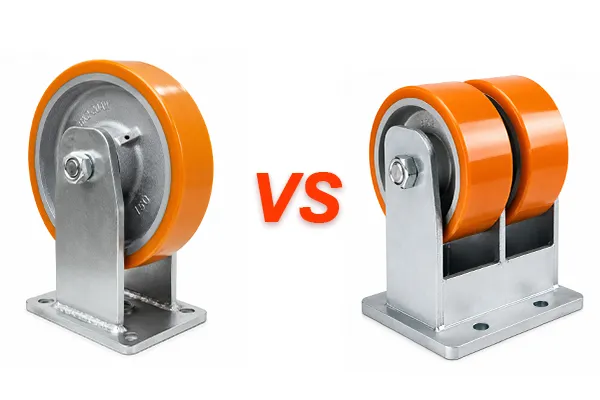
The correct choice depends on the complete caster assembly, not the number of wheels alone. Load distribution, wheel diameter, tread material, floor condition, swivel geometry, installation space, movement method and maintenance access all affect the result.
This guide compares single wheel vs dual wheel casters for extra heavy duty industrial equipment. It explains where each structure performs well, what its limitations are and what buyers should verify before specifying a production caster.
If the first question is whether the application requires heavy duty or extra heavy duty construction, review the differences between heavy duty and extra heavy duty casters before comparing wheel configurations.
Single-Wheel vs Dual-Wheel Casters at a Glance
| Selection factor | Single-wheel caster | Dual-wheel caster |
|---|---|---|
| Basic structure | One wheel in one caster rig | Two parallel wheels in one caster rig |
| Assembly width | Usually narrower | Usually wider |
| Capacity within limited height | May require a wider or larger-diameter wheel | Can often provide more capacity without increasing wheel diameter |
| Swivel behavior | One wheel follows one path | Independently rotating wheels can turn at different speeds |
| Floor contact | One contact patch | Two contact patches when both wheels contact the floor effectively |
| Obstacle crossing | Can accommodate a larger wheel within a given assembly width | Two smaller wheels do not automatically cross obstacles as well as one larger wheel |
| Debris exposure | Fewer gaps and wheel components | More spaces where chips, fibers or dirt may collect |
| Maintenance | Usually fewer bearings and wear points | Two wheels and additional bearings require inspection |
| Typical selection direction | Width-restricted, debris-prone or simpler applications | Very high capacity with limited wheel diameter or overall height |
Neither column represents a universal winner. The table is a screening tool; the final decision must use the rated performance and dimensions of the complete caster.
What Is a Single-Wheel Extra Heavy Duty Caster?
A single-wheel caster has one wheel mounted between the legs of a rigid or swivel fork. The wheel may be narrow or wide and can be made from polyurethane, PA nylon, MC nylon, cast iron, forged steel or another material selected for the floor and operating environment.
“Single wheel” does not mean light duty. A high-strength wheel, appropriate bearings, a heavy axle, a reinforced fork and a suitable swivel section can create a single-wheel assembly for multi-ton equipment. BigCaster’s extra heavy duty caster range includes configurations intended for demanding industrial loads, and the complete assembly rating should always be checked rather than inferred from wheel count.
Single-wheel casters are often selected because they provide:
- A relatively narrow wheel and fork envelope
- Fewer wheel bearings and components
- Easier access for inspection and replacement
- Less space for debris to become trapped between parallel wheels
- The option to use a larger wheel diameter where overall height permits
- Straightforward rigid, swivel, brake and directional-lock configurations
The primary limitation is packaging capacity into a restricted height. If the application needs a much higher rating, a single resilient-tread wheel may have to become wider or larger in diameter. That can increase overall caster height, swivel radius or stationary turning resistance.
What Is a Dual-Wheel Extra Heavy Duty Caster?
A dual-wheel caster—also called a twin-wheel or double-wheel caster—places two wheels side by side within one complete caster assembly. The assembly can be rigid or swivel and may use polyurethane, nylon, MC nylon, steel or other wheel materials.
The two wheels commonly rotate independently around the axle. When a swivel caster changes direction, the inside wheel follows a shorter arc than the outside wheel. Independent rotation lets the wheels turn at different speeds, creating a differential effect that can reduce tread scrub and swivel resistance.
A dual-wheel caster should still be treated as one caster assembly. Its rated capacity is limited by the complete structure, including:
- Both wheels and their hubs
- Wheel bearings
- Axle and spacers
- Fork legs and welds
- Swivel bearings and raceways
- Kingpin or kingpinless swivel structure
- Mounting plate
- Brake or directional-control components
- Fasteners and the equipment mounting frame
It is therefore incorrect to select a dual caster by adding together two unrelated wheel ratings. Use the tested or declared rating of the complete assembly under the applicable speed and operating conditions.
Buyers who already know that a twin-wheel configuration is required can browse BigCaster’s dual wheel caster options. The sections below explain when that structure is preferable to a single-wheel design.
The Main Differences Between Single and Dual Wheel Casters
1. Load Capacity
Two wheels create the opportunity to divide vertical load across two hubs, two sets of wheel bearings and two tread contact areas. Within a similar wheel diameter, a properly engineered dual-wheel assembly can therefore provide a higher capacity than a related single-wheel assembly.
That does not establish a universal two-to-one relationship. The second wheel does not double the strength of the swivel section, mounting plate, fork or equipment frame. A wider axle may also experience different bending forces, and the two wheels may not carry exactly equal loads.
When comparing single vs dual wheel heavy duty casters, use these rules:
- Compare complete caster ratings, not loose-wheel ratings.
- Confirm whether the rating is static, dynamic or defined at a particular speed.
- Check whether the two configurations use the same swivel rig, axle and mounting plate.
- Verify that the floor allows both dual wheels to carry load effectively.
- Apply the equipment-level calculation separately from the product rating.
The required capacity per caster depends on maximum equipment weight, payload, effective supporting caster count, uneven load distribution, impact, speed and duty cycle. Those calculations are covered in the extra heavy duty caster load capacity guide. You can also use the caster wheel load capacity calculator for an initial estimate.
2. Overall Height and Available Installation Space
One of the strongest reasons to use extra heavy duty dual wheel casters is to achieve a high capacity without installing a much larger-diameter wheel.
Suppose a machine design has a strict maximum caster height. A larger single wheel may provide the desired capacity and rollability, but its diameter could raise the equipment above the allowed height. A dual caster can place two smaller wheels beneath one rig, increasing the potential wheel-system capacity while keeping the wheel diameter—and therefore overall caster height—under control.
This is useful for:
- Low-profile mold and die carts
- Mobile machinery with a low center-of-gravity target
- Heavy industrial platforms
- Tooling and assembly fixtures
- Equipment that must pass beneath a fixed clearance
- Replacement projects that must match an existing installed height
The trade-off moves from height to width. A dual-wheel assembly needs room for two wheels, hub spacing, fork legs, axle components and brake hardware. The equipment designer must check total caster width and the complete 360-degree swivel envelope.
Do not compare wheel diameter alone. Request the actual overall height, swivel radius, total wheel-set width and mounting dimensions for both candidate assemblies.
3. Contact Pressure and Floor Loading
Dual-wheel casters are frequently described as reducing floor pressure because the load is spread across two wheels. This can be directionally correct, but the real contact condition is more complex than dividing pressure by two.
Both wheels must touch the floor and share load effectively. Actual distribution depends on:
- Floor flatness
- Axle alignment and stiffness
- Wheel diameter tolerance
- Tread crown or profile
- Polyurethane or rubber deformation
- Hub and bearing clearances
- Fork rigidity
- Whether the axle can oscillate or equalize
On a level floor with matched wheels, a dual configuration may create two useful contact areas and reduce the load carried through each wheel. On an uneven floor, one wheel can become more heavily loaded while the other carries less. A hard wheel with a narrow actual contact band may also create substantial local stress even when two wheels are present.
Wheel count cannot replace material selection. A hard steel or MC nylon dual wheel may impose more local floor stress than a correctly selected polyurethane single wheel. Floor protection must consider tread hardness, wheel width, contact shape, load, debris and floor compressive strength together.
A technically cautious specification should state:
Dual wheels may reduce localized floor loading when both wheels maintain effective contact and share the load as intended.
It should not claim that every dual caster cuts floor pressure in half.
4. Turning Resistance and Differential Action
Turning behavior is the most important mechanical difference between a wide single wheel and two independently rotating wheels.
When a swivel caster rotates around its vertical axis, the portions of the tread on the inside and outside of the turn do not travel the same distance. A single wide wheel must accommodate that difference through elastic deformation, slip or scrub across the floor. Under a very high load, the resulting friction can make the caster difficult to swivel.
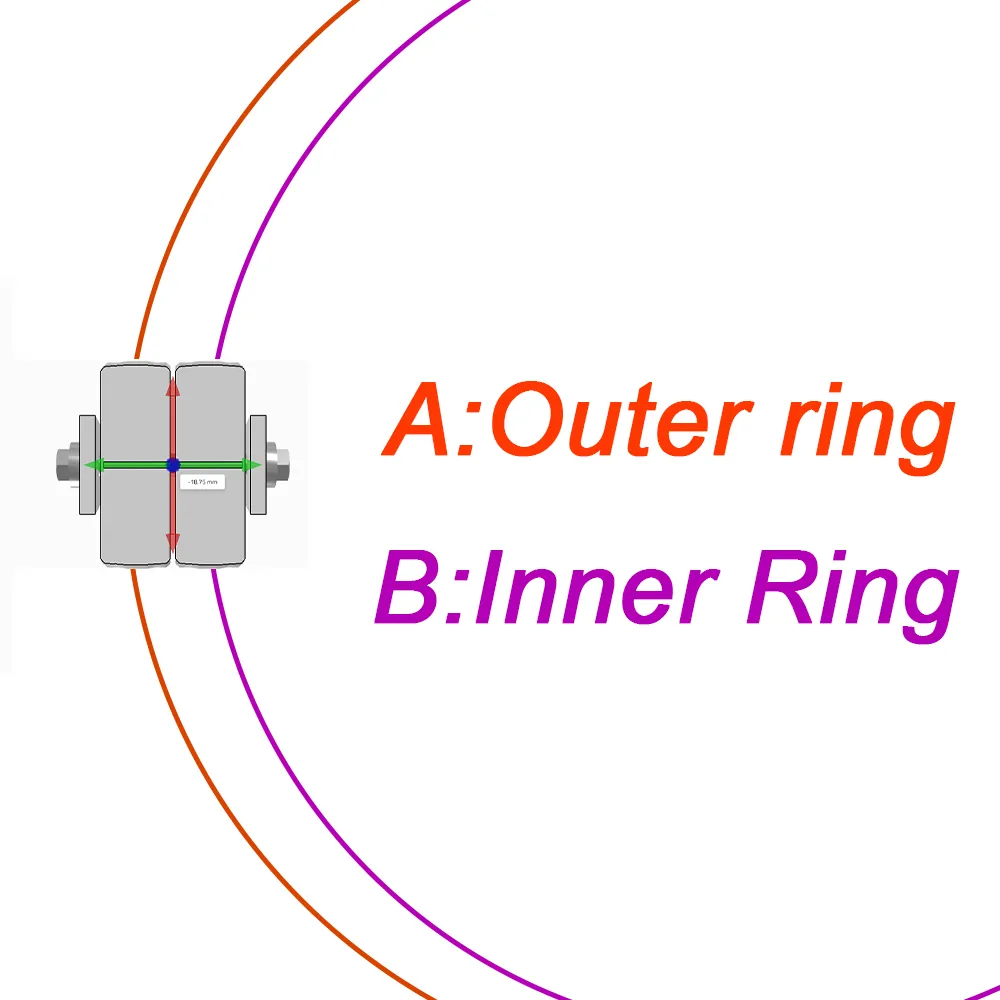
In a dual-wheel caster, the inside wheel follows a smaller arc and the outside wheel follows a larger arc. If the wheels rotate independently, the outside wheel can rotate farther and faster than the inside wheel. This differential action can reduce scrubbing, especially with wide polyurethane or rubber treads.
However, dual wheel caster turning resistance is not always lower. The expected benefit can be reduced when:
- The wheels do not rotate independently
- Bearings are contaminated, damaged or excessively tight
- One wheel carries most of the load
- Debris becomes trapped between or beneath the wheels
- The tread materials or wheel diameters no longer match because of wear
- The swivel bearing or caster geometry is unsuitable
- The equipment is forced to pivot without allowing the wheels to roll
Even a well-designed dual swivel caster can require substantial force to change direction under a stationary multi-ton load. Differential action helps most when the wheels are allowed to roll through the turn. It does not eliminate swivel bearing friction, caster offset forces or floor deformation.
This distinction is important for manually moved equipment. A high load rating proves that a caster can support a defined load under its rating conditions; it does not prove that an operator can safely start, steer and stop the equipment.
5. Straight-Line Rolling Resistance
Easier swiveling does not automatically mean easier straight-line travel. Starting and continuous rolling resistance are influenced by:
- Wheel diameter
- Tread hardness and resilience
- Wheel width and deformation
- Bearing type and condition
- Floor material and roughness
- Wheel alignment
- Total load
- Speed and operating temperature
A dual arrangement divides the load between two wheels, which may reduce tread deformation per wheel in some designs. It also adds wheel bearings, seals and potential alignment differences. The net result must be evaluated with the actual caster and application.
Wheel diameter remains particularly important. A large-diameter single wheel may cross expansion joints, small gaps and debris more easily than two smaller-diameter wheels. Adding a second wheel does not change the geometric relationship between wheel radius and obstacle height.
For long travel routes, compare both starting force and sustained rolling force at the intended load. For powered towing, also verify speed rating, heat buildup, bearing suitability, tread bond and swivel stability.
6. Equipment Stability
A dual-wheel caster creates a wider local footprint than a single-wheel caster. That can provide more support at the caster position and may improve the behavior of certain low-profile platforms or fixtures.
It does not guarantee that the complete equipment is stable. Overall stability depends primarily on:
- Distance between caster positions
- Equipment wheelbase and track width
- Center-of-gravity height
- Load position and movement
- Frame stiffness
- Floor slope and irregularities
- Acceleration, braking and turning forces
- Swivel-caster orientation
On a large machine, the additional width between the two wheels in one caster may be small compared with the distance between the four caster mounting points. A tall, top-heavy machine can still be unstable on dual wheels. Conversely, a low, wide platform may be stable on properly positioned single-wheel casters.
Use dual-wheel width as one input to the stability review, not as a substitute for an equipment-level tipping and load-transfer assessment.
7. Performance on Uneven Floors
Two wheels do not automatically provide better load sharing on an uneven surface.
A conventional dual-wheel caster may mount both wheels on one rigid axle. If the floor rises beneath one wheel, that wheel can receive more load. The other wheel may become lightly loaded or temporarily lose effective contact. This reduces the expected load-distribution benefit and can produce uneven wear.
Some specialized twin-wheel casters use an oscillating axle, rocker or equalizing structure. This allows the wheel pair to articulate so that both wheels can follow small differences in floor level. Such arrangements can improve contact and load sharing, but they introduce additional joints, movement and maintenance requirements.
For rough floors, consider all of the following before choosing a dual caster:
- Maximum joint, gap and threshold size
- Wheel diameter
- Tread resilience and impact resistance
- Travel speed
- Whether the two wheels are rigidly or articulately mounted
- Fork and swivel impact capacity
- Risk of debris entering the space between the wheels
- Frame load distribution
If the primary problem is crossing a large floor joint, a larger-diameter single wheel may perform better than a smaller-diameter dual-wheel set. If the primary problem is maintaining a low equipment height while sharing load across minor floor variation, an engineered oscillating dual-wheel solution may be appropriate.
8. Mounting Width and Swivel Clearance
Single-wheel casters generally fit into a narrower envelope. This can be important where a caster must sit between frame members, inside a recessed pocket or close to guards and leveling feet.
Dual-wheel casters require room for:
- Both wheels and hubs
- Clearance between the wheels
- Wider fork or axle structure
- Brake mechanisms
- Swivel rotation
- Maintenance access
Check the entire swept envelope rather than the caster’s width in its straight-ahead position. During a 360-degree turn, the wheel pair may move beneath frame members, tow bars, cables or adjacent caster assemblies.
The mounting plate may also become larger because the dual assembly carries a greater load or generates higher turning moments. Verify plate length, width, thickness, hole pattern, bolt size and frame reinforcement. Matching bolt holes does not prove that an existing frame can support the new caster forces.
9. Bearings, Wear and Maintenance
A single-wheel caster normally has fewer wheel bearings, seals and tread surfaces to inspect. The axle is more accessible, and there is no central gap between parallel wheels to trap material. This can make single-wheel designs attractive in environments containing metal chips, fibers, packaging film or sticky contamination.
A dual-wheel caster adds inspection points. Maintenance should check:
- Both wheel treads for cuts, flat spots and uneven diameter
- Every wheel bearing for play, noise and resistance
- Axle, spacers and retaining hardware
- Debris between the two wheels
- Unequal wheel rotation
- Fork-leg distortion
- Swivel bearing wear
- Brake contact on both wheels, where applicable
If one wheel becomes smaller through wear or its bearing begins to seize, the two wheels may no longer share load or create effective differential action. Replacing only one wheel can also produce a diameter mismatch. Unless the manufacturer approves an individual replacement, matched wheel replacement may be the better maintenance direction.
Brake design deserves specific attention. A device that stops only one wheel may not provide the same holding behavior as a system that controls both. Confirm whether the specified wheel brake, total lock or floor lock is designed for the complete dual-wheel assembly. Caster brakes should not be assumed to secure equipment on a slope unless the system is specifically evaluated for that purpose.
Advantages of Single-Wheel Extra Heavy Duty Casters
Single-wheel casters remain a strong choice when their complete rated capacity satisfies the application. Their main advantages include:
Narrower installation envelope
One wheel generally requires less total assembly width. This helps with compact frames, recessed mounting locations and equipment where adjacent components limit swivel clearance.
Simpler construction
Fewer wheels and wheel bearings can simplify inspection, spare-parts management and replacement. There are also fewer gaps where debris can accumulate.
More room for wheel diameter
If width is constrained but height is available, a single larger-diameter wheel may provide better obstacle crossing and lower rolling resistance than a pair of smaller wheels.
Straightforward behavior
There is no need to maintain matched wear and independent rotation between two parallel wheels. This can be valuable in dirty or low-maintenance environments.
Potential cost and weight advantages
A suitable single-wheel configuration may contain fewer components and weigh less than a comparable dual-wheel assembly. Actual pricing still depends on material, bearings, fork construction and capacity.
These advantages do not make single-wheel casters universally easier to turn. An extremely wide resilient wheel under a high load can create substantial tread scrub while swiveling.
Advantages of Dual-Wheel Extra Heavy Duty Casters
The strongest dual wheel caster advantages appear when the equipment has a specific packaging or maneuvering problem.
High capacity within limited overall height
Two wheels can place more load-carrying structure beneath one caster without requiring the diameter of a much larger single wheel. This is one of the most practical reasons to choose dual wheels for low-profile heavy equipment.
Differential action during turns
Independently rotating wheels can travel at different speeds through a turn. This may reduce the scrub created by one very wide wheel, particularly with polyurethane or other resilient treads.
Two contact areas
When the floor and caster structure allow effective sharing, the load can be divided between two wheel contact patches. This may reduce the demand on each wheel and distribute load over a wider local area.
Wider local support
The wheel pair creates a wider base at the individual caster position. This may be useful in selected platforms and tooling fixtures, although complete equipment stability must still be evaluated.
More high-capacity configuration options
Dual-wheel assemblies can combine different diameters, materials, bearings, swivel structures and control options to meet demanding industrial requirements. BigCaster’s category includes dual-wheel polyurethane, nylon, MC nylon and steel configurations for application-specific review.
Disadvantages and Limitations of Dual-Wheel Casters
Dual wheels solve some design constraints by introducing others. Their limitations include:
- Greater overall assembly width
- More wheel bearings and wear components
- Additional spaces for debris and contamination
- Potentially higher product and maintenance cost
- Need to keep wheel diameters and bearing condition matched
- Unequal load sharing on irregular floors
- More complex braking arrangements
- No automatic improvement in obstacle crossing
- Possible interference through the swivel envelope
- More detailed inspection requirements
There can also be a false sense of capacity. A buyer may assume that two wheels make the caster safe for a given load without confirming the fork, swivel section, mounting plate or frame. Dual wheel caster load capacity must always come from the rated complete assembly.
When Should You Choose a Single-Wheel Caster?
A single-wheel extra heavy duty caster is usually the better starting direction when:
- The available single-wheel assembly already meets the required capacity
- Installation width is more restricted than overall height
- The route contains joints or thresholds that favor a larger wheel diameter
- Metal chips, fibers or other debris could collect between dual wheels
- Simple inspection and maintenance are priorities
- Spare-parts standardization favors one wheel construction
- The equipment travels mainly in straight lines
- A suitable hard wheel can carry the load without excessive width
- Lower caster weight or component count is desirable
Example: A heavy industrial cart must pass over substantial expansion joints but has enough vertical clearance for a larger wheel. If a large-diameter single-wheel caster meets capacity and push-force requirements, it may outperform a smaller dual-wheel caster at the joints while remaining easier to clean.
When Should You Choose a Dual-Wheel Caster?
An extra heavy duty dual wheel caster is usually worth evaluating when:
- Very high capacity is required at each caster position
- Overall caster height or wheel diameter is strictly limited
- A resilient polyurethane tread is preferred, but a practical single wheel cannot meet capacity and height requirements
- The equipment must change direction frequently under a high load
- Differential wheel action can reduce the scrub of a wide tread
- A wider local contact area is beneficial
- The equipment is a low-profile mold cart, tooling cart, industrial platform or heavy fixture
- The frame provides enough width and swivel clearance
- Maintenance staff can inspect both wheels and their bearings
Example: A low-profile mold cart must carry a concentrated load on smooth concrete. Increasing single-wheel diameter would raise the deck beyond its height limit, while an extremely wide single polyurethane wheel would be difficult to swivel. A properly rated dual-wheel polyurethane assembly may package the required capacity within the available height and allow the wheels to rotate differentially during turns.
Single vs Dual Wheel Caster Selection Matrix
| Application condition | Initial selection direction | Reason | What must still be verified |
| Extremely high load with restricted height | Dual wheel | More capacity can be packaged within a smaller wheel diameter | Complete assembly rating, width and mounting strength |
| Narrow equipment frame | Single wheel | Usually requires less total assembly width | Capacity, wheel width and swivel clearance |
| Large joints or thresholds | Larger-diameter single wheel may be preferable | Obstacle crossing depends strongly on diameter | Required push force, impact and overall height |
| Heavy load with frequent pivoting | Dual wheel with independent wheel rotation | Differential action may reduce tread scrub | Swivel bearing, floor, wheel material and loaded turning test |
| Metal chips or fibrous debris | Single wheel | Fewer debris-trap areas | Tread cut resistance and bearing seals |
| Floor-sensitive equipment | Application-specific | Material and actual contact pressure matter as much as wheel count | Floor strength, tread hardness, contact area and load sharing |
| Uneven floor | Large single wheel or equalizing dual design | Ordinary rigid dual wheels may not share load equally | Floor profile, articulation and dynamic impact |
| Long-distance powered towing | Engineering review required | Speed, heat, alignment and swivel stability may dominate | Dynamic rating, duty cycle, bearings and route |
| Low-profile tooling or mold cart | Dual wheel or purpose-built low-profile caster | High capacity within limited height | Ground clearance, width, braking and loaded stability |
| Simple low-frequency repositioning | Single wheel may be sufficient | Fewer components can meet occasional-movement needs | Flat spotting, parking supports and actual capacity |
This matrix identifies a direction, not a final part number. Use the complete application framework in How to Choose Extra Heavy Duty Casters for Industrial Equipment to confirm wheel material, diameter, bearings, caster layout, mounting and environment.
Worked Example: Choosing Casters for a Low-Profile Industrial Platform
Consider a mobile industrial platform with these preliminary requirements:
- Maximum loaded weight: 12,000 kg
- Installed caster positions: four
- Design assumption: three casters may carry the effective load on an uneven floor
- Movement: low-speed manual or power-assisted repositioning
- Floor: generally smooth industrial concrete with expansion joints
- Requirement: polyurethane tread for lower noise and better floor protection than bare metal
- Constraint: strict maximum platform height
- Maneuvering: frequent changes of direction in a work area
Step 1: Establish the required capacity direction
Before an application allowance is applied, dividing 12,000 kg by three effective supporting casters gives 4,000 kg per caster. The final requirement must add an allowance based on the real impact, movement method, speed and risk assessment.
This does not mean that any caster labeled 4,000 kg is suitable. The rating conditions and complete assembly must be reviewed.
Step 2: Compare a single-wheel concept
A polyurethane single wheel might need a large diameter, substantial tread volume, a strong core and large bearings to reach the required capacity. Its larger diameter may improve performance at the expansion joints, but it could raise the platform above the height limit. A very wide resilient tread may also create high stationary swivel resistance.
Step 3: Compare a dual-wheel concept
Two smaller polyurethane wheels may package the required capacity direction within a lower overall height. If they rotate independently, differential action may reduce scrub during steering. The wider local footprint may also distribute the load across two contact patches on the smooth floor.
The dual concept still requires verification of:
- Complete caster dynamic rating
- Total wheel-set and fork width
- Mounting plate and frame strength
- Swivel radius and interference
- Wheel-bearing and swivel-bearing construction
- Load sharing between the two wheels
- Expansion-joint impact
- Brake or directional-lock operation
- Loaded steering force
Step 4: Make a conditional recommendation
The dual-wheel polyurethane direction is attractive because height and loaded maneuvering are major constraints. It should not be approved solely from the calculated capacity. The final assembly requires drawing review, representative samples and a loaded test on the real route.
If the expansion joints prove too severe for the smaller dual wheels, the project may need a larger wheel, route modification, resilient or spring-loaded structure, or a revised platform height. The selection process should expose that trade-off rather than hide it behind a higher load number.
How to Compare Single and Dual Wheel Caster Specifications
Request comparable data for both alternatives. A useful comparison sheet should include:
| Specification | Why it matters |
| Complete caster rated capacity | Confirms the limit of the full assembly rather than the loose wheel |
| Rating condition and speed | Distinguishes static or low-speed data from the intended operation |
| Wheel diameter | Influences overall height, obstacle crossing and rolling effort |
| Individual wheel width | Helps evaluate tread deformation and contact behavior |
| Total wheel-set width | Determines packaging and local footprint |
| Overall caster height | Confirms equipment height and replacement fit |
| Swivel radius | Defines the space needed for 360-degree rotation |
| Caster offset or swivel lead | Influences steering force and dynamic behavior |
| Wheel material and hardness | Affects floor protection, rolling resistance, wear and environment |
| Wheel core and tread bond | Important for resilient wheels under high loads and repeated movement |
| Wheel-bearing type and quantity | Influences capacity, speed, rolling resistance and maintenance |
| Independent wheel rotation | Determines whether differential action can occur in a dual caster |
| Rigid or oscillating dual axle | Influences contact and load sharing on uneven floors |
| Swivel-bearing construction | Carries vertical, side and turning loads |
| Mounting plate and bolt pattern | Connects the caster safely to the equipment frame |
| Brake and lock function | Clarifies whether wheel rotation, swivel rotation or both are controlled |
| Operating temperature and chemicals | Determines material, grease, seal and finish compatibility |
| Inspection and lubrication requirements | Establishes lifecycle workload and access needs |
If a supplier cannot provide every value initially, identify the gaps and resolve them during drawing and sample review.
BigCaster Single- and Dual-Wheel Configuration Examples
The following products show how wheel count, material and capacity can be configured differently. Product ratings vary by diameter and exact model; review the current datasheet before selection.
Wheel count should also be separated from material choice. Buyers can compare the broader ranges of polyurethane casters, nylon casters and steel caster wheels before deciding whether the selected material should use a single- or dual-wheel structure.
Extra Heavy Duty Dual-Wheel Nylon Caster E0501
The E0501 dual-wheel nylon caster uses two PA nylon wheels for a high-capacity, compact arrangement. It is a relevant direction where hard, wear-resistant wheels and limited installation height are more important than tread cushioning.
Super Heavy Duty Dual-Wheel Steel Caster E0301
The E0301 dual-wheel steel caster is intended for exceptionally demanding load conditions on a floor compatible with hard steel wheels. Noise, shock transmission, floor stress and route condition require careful review.
Extra Heavy Duty MC Nylon Single-Wheel Caster E0601
The E0601 MC nylon caster demonstrates that a single-wheel construction can still provide multi-ton capacity. It may suit applications that have enough height for the available diameters and need a narrower, hard-wheel configuration.
Extra Heavy Duty Iron-Core Polyurethane Single-Wheel Caster E0701
The E0701 iron-core polyurethane caster combines a single wheel with a resilient tread direction. It offers a useful comparison against dual polyurethane alternatives when buyers must balance floor protection, assembly width, capacity and swivel effort.
These examples are not interchangeable. A valid comparison must use the required diameter, load, speed, mounting dimensions and operating environment.
10 Common Single- and Dual-Wheel Selection Mistakes
1. Assuming two wheels automatically double capacity
The fork, swivel section, axle and mounting plate do not become twice as strong simply because another wheel is installed.
2. Comparing loose-wheel capacity with complete caster capacity
A wheel rating cannot replace the rating of the assembled swivel or rigid caster.
3. Assuming the load is divided perfectly between two wheels
Floor unevenness, wheel tolerances, tread deformation and axle stiffness can create unequal loading.
4. Claiming that dual wheels always halve floor pressure
Actual contact pressure depends on contact area, material, load sharing and the floor.
5. Treating easier swiveling as lower rolling resistance
Differential action can reduce turning scrub, but straight-line rolling follows a different set of variables.
6. Replacing one large wheel with two smaller wheels without checking obstacles
Smaller wheels may have more difficulty crossing joints, gaps and debris.
7. Ignoring total caster width
A dual-wheel assembly can interfere with frame members, guards, locks or neighboring components during swiveling.
8. Assuming ordinary dual wheels are ideal for uneven floors
A rigid axle can concentrate load on one wheel. An articulating design may be needed when equalized contact is important.
9. Failing to maintain matched wheels
Unequal tread wear, bearing drag or different replacement diameters can reduce differential action and load sharing.
10. Skipping a loaded route test
Catalog data cannot reveal every interaction among floor joints, steering force, clearance, noise, brakes and the equipment frame.
Validation Before Production
After choosing a preliminary single or dual wheel direction, validate it in stages.
Review application data
Confirm maximum total load, effective supporting caster count, center of gravity, movement method, speed, floor, obstacles, environment and dimensional constraints.
Approve the caster drawing
Check wheel material, dimensions, total width, overall height, swivel radius, mounting plate, bolt pattern, bearing arrangement and control features. For dual casters, confirm independent wheel rotation and whether the axle is rigid or oscillating.
Inspect representative samples
Verify mounting fit, wheel rotation, swivel action, dimensional clearance and brake or lock operation. Check that both wheels in a dual caster contact a representative floor.
Conduct a loaded route test
At the maximum intended operating load, evaluate:
- Starting and continuous force
- Swivel effort and directional changes
- Straight-line tracking
- Joint and threshold crossing
- Noise and vibration
- Floor marking or damage
- Wheel and bearing temperature
- Brake and lock behavior
- Load stability
- Clearance through the full swivel range
For powered towing, conduct a controlled engineering test at the intended speed and duty cycle. Inspect for caster flutter, heat, tread damage, unequal wear, looseness and abnormal noise.
Establish the maintenance standard
Define inspection frequency, acceptable tread wear, bearing-play limits, fastener checks, lubrication, cleaning and replacement rules. A dual-wheel maintenance plan should explicitly address matched wheel condition and debris between the wheels.
Information to Send BigCaster for a Recommendation
To compare single or dual wheel casters for heavy equipment, provide:
- Equipment description, drawings and photographs
- Empty equipment weight
- Maximum payload and total operating weight
- Number and location of caster positions
- Center-of-gravity or uneven-load information
- Maximum overall caster height
- Maximum assembly width and swivel clearance
- Mounting plate dimensions and bolt pattern
- Manual, power-assisted or towed movement
- Normal and maximum speed
- Travel distance and cycles per day
- Floor type and route photographs
- Joint, gap and threshold dimensions
- Required wheel material or floor-protection priority
- Water, chemicals, temperature and debris exposure
- Swivel, rigid, brake or directional-lock requirements
- Current caster problems, if replacing an existing design
- Project quantity and validation requirements
BigCaster can review standard and custom extra heavy duty caster configurations by capacity, material, dimensions, mounting and operating conditions. No fixed minimum purchase quantity is required for standard project discussions, while the practical requirements of customized components should be confirmed during quotation.
Frequently Asked Questions
Are dual wheel casters stronger than single wheel casters?
Not automatically. A dual-wheel design can provide a higher rating within a similar wheel diameter, but the complete caster is limited by its wheels, bearings, axle, fork, swivel section and mounting plate. Some single-wheel extra heavy duty casters also carry multi-ton loads. Compare manufacturer ratings for the complete assemblies.
Do dual wheel casters carry twice the load?
There is no universal rule that a dual-wheel caster carries exactly twice as much as a single-wheel caster. The second wheel increases load-carrying potential, but it does not double every structural component. Load sharing between the wheels may also be unequal on an imperfect floor.
Are dual wheel casters easier to turn?
They can be. When the two wheels rotate independently, the inside and outside wheels can turn at different speeds through a curve. This differential action may reduce tread scrubbing compared with one very wide wheel. The benefit depends on bearings, load distribution, tread, floor and whether the equipment moves slightly while changing direction.
Do dual wheel casters reduce floor pressure?
Dual wheels may distribute load across two contact areas when both wheels touch the floor and share the load. The pressure is not necessarily reduced by exactly half. Wheel material, tread shape, deformation, floor flatness and axle construction affect the actual result.
Are dual wheel casters better for uneven floors?
Not necessarily. A rigid dual-wheel axle may place more load on one wheel when the floor is uneven. An oscillating or equalizing design can improve contact, but the wheel diameter, impact, debris and route must still be considered. A larger single wheel may cross substantial obstacles more effectively.
Do dual wheel casters have a lower overall height?
Dual wheels can often achieve a high capacity with a smaller wheel diameter than a comparable single-wheel concept, which helps limit overall caster height. The actual height must be compared using product drawings; two wheels alone do not make an assembly low profile.
Are single-wheel casters easier to maintain?
They usually have fewer wheel bearings and no gap between parallel wheels, which can simplify cleaning and inspection. Maintenance demand still depends on bearing type, seals, wheel material, environment and duty cycle.
When should I use dual wheel extra heavy duty casters?
Consider dual wheels when the application needs very high capacity within a restricted wheel diameter or overall height, or when frequent loaded steering may benefit from differential wheel action. Confirm total width, floor contact, complete assembly rating, braking and maintenance before final selection.
Final Answer: Single or Dual Wheel Casters?
Choose a single-wheel extra heavy duty caster when the required capacity is already available and the application benefits from a narrower assembly, larger wheel diameter, simpler maintenance or better resistance to trapped debris.
Choose a dual-wheel extra heavy duty caster when exceptionally high capacity must fit within limited overall height, or when independently rotating wheels can reduce the turning scrub of a wide, heavily loaded tread.
The wheel count is only the beginning of the decision. A reliable specification must still confirm:
- Capacity of the complete caster assembly
- Real load distribution on the equipment and between the wheels
- Wheel diameter, material and floor compatibility
- Turning and straight-line rolling performance
- Overall height, total width and swivel clearance
- Mounting-frame strength
- Speed, duty cycle and operating environment
- Brake, inspection and maintenance requirements
When those factors are compared with actual product drawings and validated under load, the choice between single and dual wheel casters becomes an engineering decision—not an assumption based on the number of wheels.