

Polyurethane is often the best all-around wheel material for heavy loads on smooth industrial floors because it can balance capacity, floor protection, noise and rolling performance. It is not always the best choice, however. MC nylon may be preferable when low deformation and high capacity matter more than cushioning. Steel or cast iron may be better in severe heat, metal debris or exceptionally demanding mechanical conditions. Rubber can provide better cushioning and quieter movement when a suitably rated construction is available.
That is why choosing a material by a simple “strongest to weakest” ranking does not work. The material that supports the highest load may damage the floor, transmit excessive shock or make the equipment too noisy. The softest material may protect the floor but deform under load and require too much force to move. A compound that performs well during occasional manual repositioning may overheat during continuous powered travel.
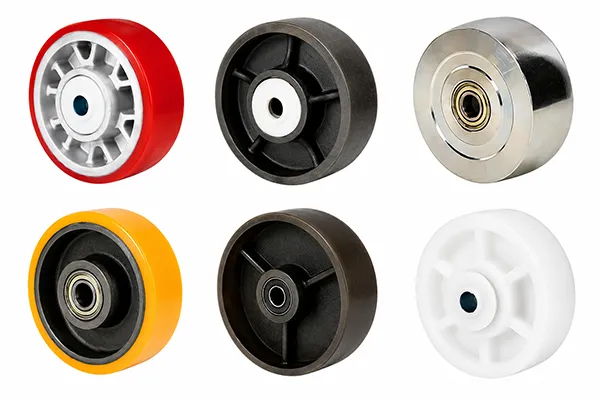
This guide compares the main extra heavy duty caster wheel materials used by BigCaster: polyurethane, PA nylon, MC nylon, cast iron, all-steel and rubber. It explains their performance, limitations, failure risks and suitable operating conditions so equipment manufacturers and industrial buyers can build a complete wheel specification.
If you are still determining the required caster capacity or overall configuration, first review the extra heavy duty caster load capacity guide and the complete guide to choosing extra heavy duty casters for industrial equipment.
Quick Answer: Which Wheel Material Is Best for Heavy Loads?
| Operating priority | Initial wheel-material direction | Main condition to verify |
|---|---|---|
| Balance load, floor protection and noise | Polyurethane on iron or steel core | Compound, tread thickness, bond, speed and heat buildup |
| Low deformation and efficient rolling on smooth floors | PA nylon or MC nylon | Noise, floor joints, moisture and impact transmission |
| High capacity in a large hard-wheel design | MC nylon | Floor strength, wheel diameter, temperature and formulation |
| Severe load or mechanical demand where floor damage is acceptable | Purpose-designed steel wheel | Floor contact stress, vibration, corrosion and complete caster rating |
| Hard, slow-moving service with wear or debris concerns | Cast iron | Impact, brittleness, floor damage and corrosion |
| Quiet movement and cushioning | Rubber, if the required capacity is available | Compression, rolling resistance, flat spotting and heat |
| High-temperature application | Suitable metal wheel with compatible bearings and lubricant | Continuous and peak temperature of the complete caster |
| Sensitive coated floor | Suitable polyurethane formulation | Contact pressure, tread hardness, debris and loaded test |
This table gives an initial direction, not a final product selection. Wheel diameter, width, core, bearings, speed, duty cycle and the complete caster rig can change the result.
Why There Is No Universal Best Caster Wheel Material
The best wheel material for heavy loads is the material that satisfies the entire operating profile with an acceptable margin—not simply the one with the hardest tread or largest published rating.
Before comparing materials, define:
- Maximum total equipment weight and payload
- Required capacity per caster
- Number of casters that will carry the load effectively
- Static, manual, power-assisted or towed movement
- Normal and maximum speed
- Distance and cycles per day
- Floor material, flatness and surface finish
- Joints, gaps, thresholds and debris
- Required starting, rolling and swivel force
- Noise and vibration limits
- Temperature range
- Water, washdown, oils and chemicals
- Wheel diameter, width and overall-height limits
- Single- or dual-wheel configuration
- Inspection and maintenance capability
These factors can conflict. A hard wheel generally deforms less under load, but it also provides less cushioning. A resilient tread can reduce noise and protect a coated floor, but repeated deformation can increase rolling resistance and generate heat. A metal wheel may tolerate conditions that damage an elastomer, yet it can concentrate very high stress on concrete.
The decision must therefore separate four questions:
- Can the wheel and complete caster carry the load?
- Can the equipment start, roll, turn and stop as required?
- Will the wheel remain compatible with the floor and environment?
- Will it provide an acceptable service life under the real duty cycle?
Only after all four are answered should one material be called the best for that application.
Extra Heavy Duty Caster Wheel Material Comparison
| Material | General load potential | Rolling on smooth floors | Floor protection | Cushioning and noise | Main strengths | Main limitations |
|---|---|---|---|---|---|---|
| Polyurethane on iron or steel core | High to very high | Good; formulation-dependent | Good compared with hard metal | Moderate cushioning; quieter than metal | Balanced industrial performance, wear resistance, multiple compounds | Heat buildup, cuts, bond failure and chemical compatibility |
| PA nylon | High in suitable designs | Very good | Better than bare metal but still hard | Low cushioning; relatively noisy | Low deformation, clean running, corrosion resistance | Shock transmission, joints, noise, moisture-related behavior |
| MC nylon | Very high in suitable large wheels | Very good | Limited cushioning | Hard and relatively noisy | High strength-to-weight direction, low deformation, large-wheel capability | Hard floor contact, impact transfer, formulation and temperature limits |
| Cast iron | High | Good on hard, smooth floors | Poor | Almost no cushioning; noisy | Wear resistance, low compression, some heat and debris applications | Floor damage, corrosion, brittleness and shock transfer |
| All-steel | Very high | Low material deformation | Very poor | No cushioning; very noisy | Severe load and mechanical conditions, impact-tough designs possible | Floor stress, vibration, corrosion and high noise |
| Rubber | Application-dependent | Usually higher resistance than hard alternatives | Very good | Very good cushioning and low noise | Vibration absorption, grip and floor protection | Compression, flat spotting, heat and limited capacity in many envelopes |
These are general directions. “Polyurethane,” “nylon,” “rubber” and “steel” each cover multiple formulations and constructions. Product drawings, material data and complete caster ratings take precedence over a generic comparison table.
1. Polyurethane Wheels for Extra Heavy Duty Casters
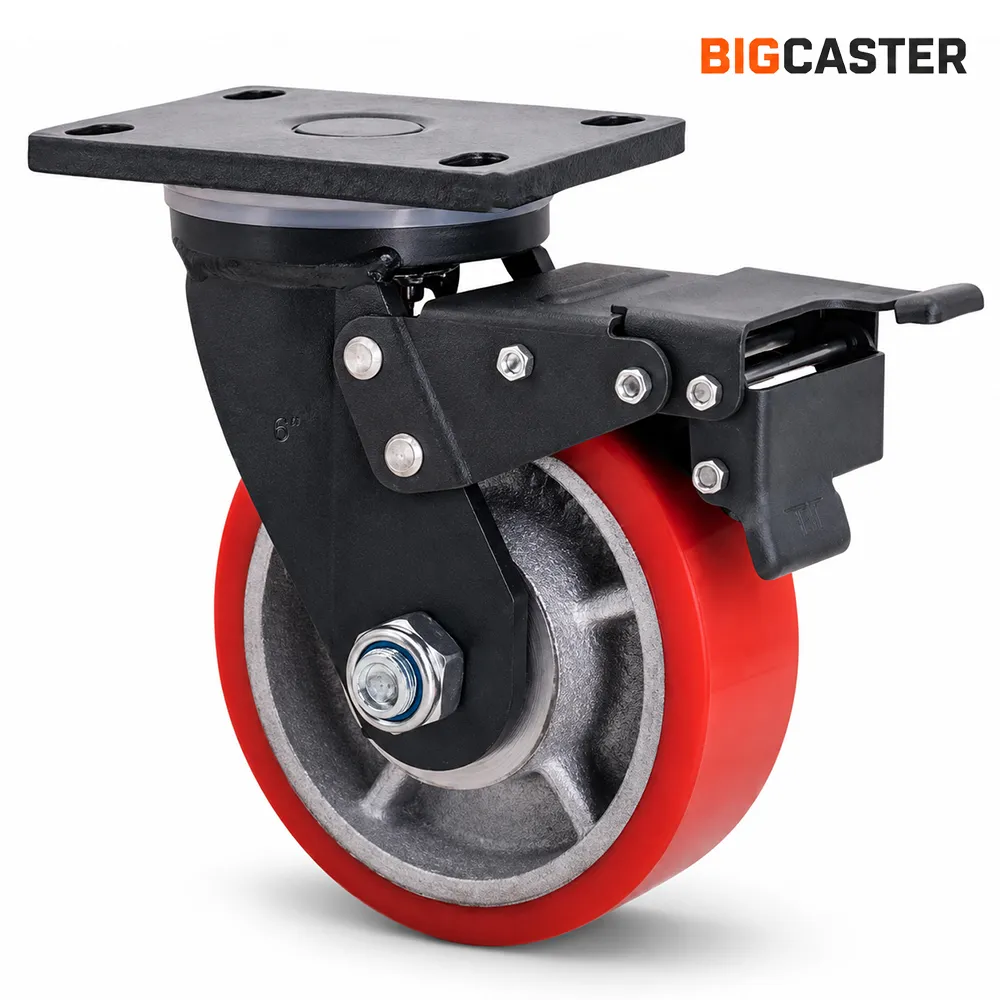
Polyurethane casters are widely used on industrial machinery, heavy platforms and material-handling equipment because a resilient tread can carry substantial load while treating the floor more gently than bare metal.
Why polyurethane is a common all-around choice
A properly selected polyurethane wheel can offer:
- Higher load potential and lower deformation than many rubber wheels of comparable size
- Better floor protection than steel or cast iron
- Lower operating noise than hard metal wheels
- Good resistance to abrasion in suitable conditions
- A range of hardnesses and formulations
- Strong iron or steel wheel cores for extra heavy duty service
- Single- and dual-wheel configuration options
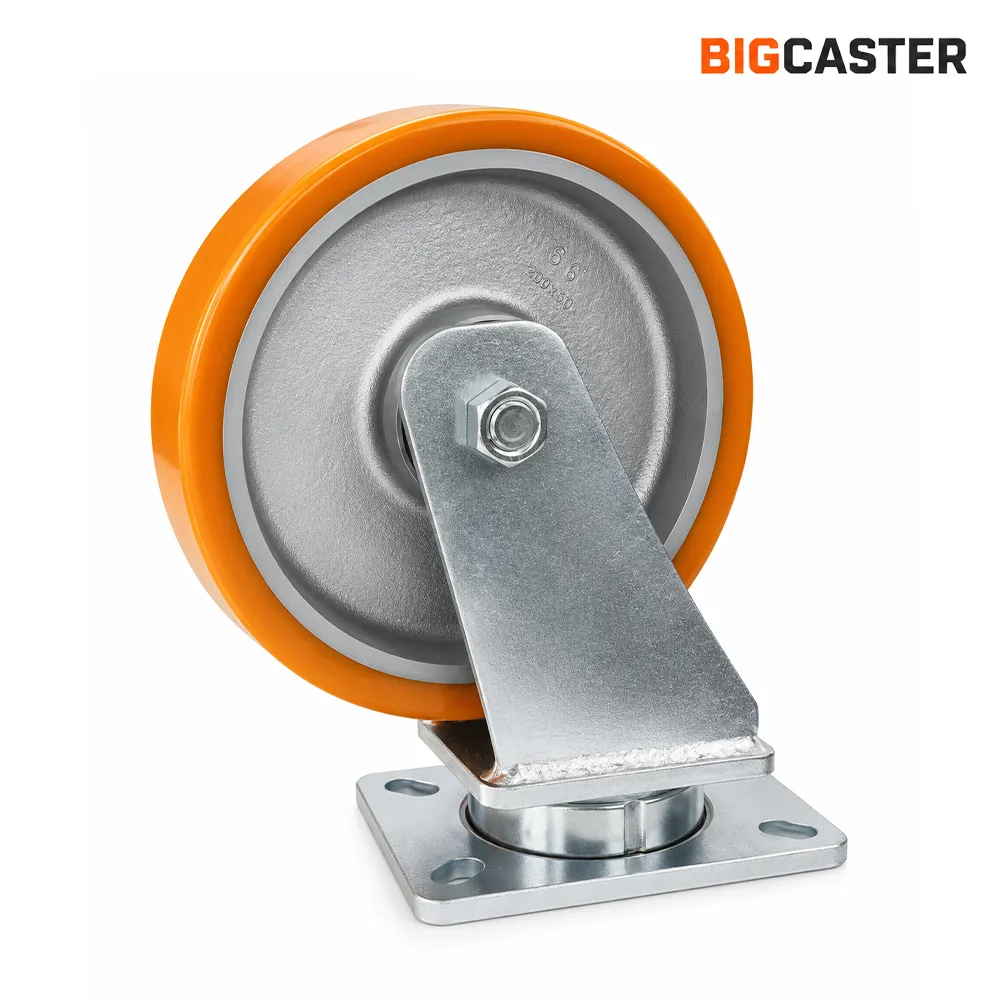
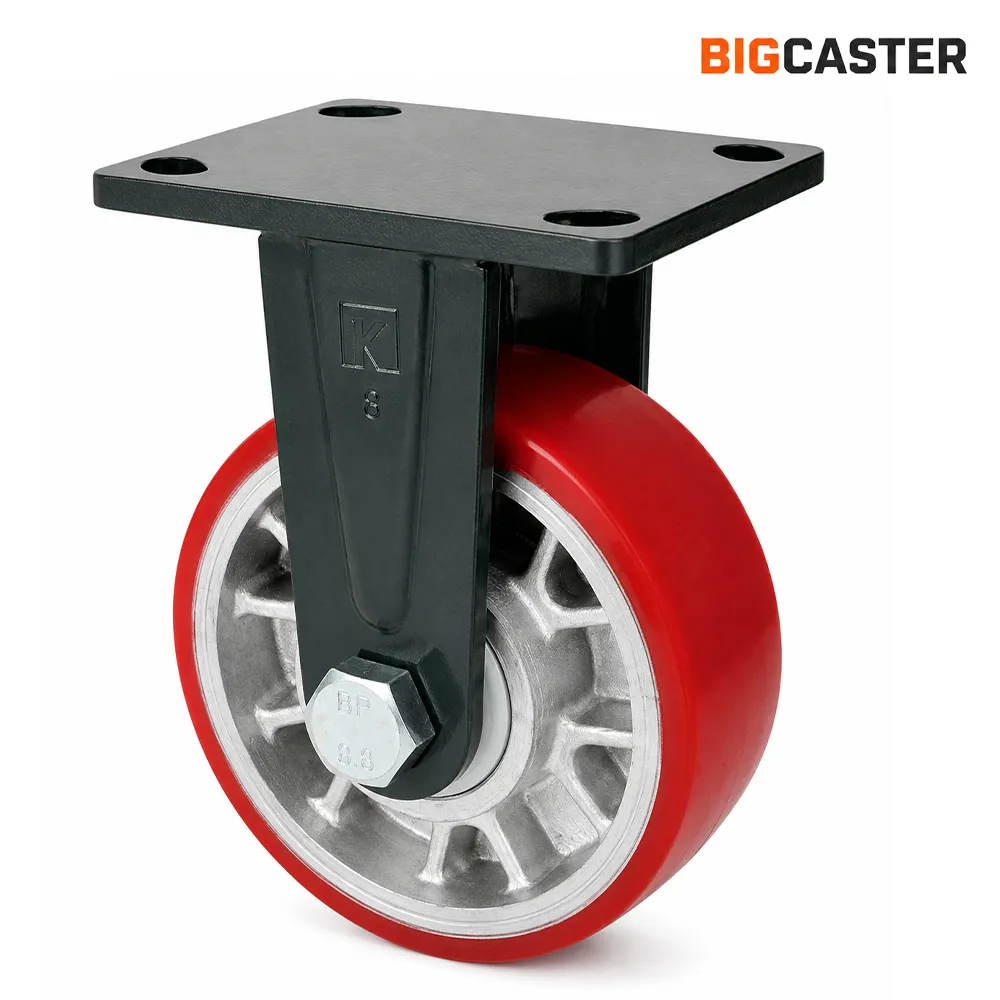
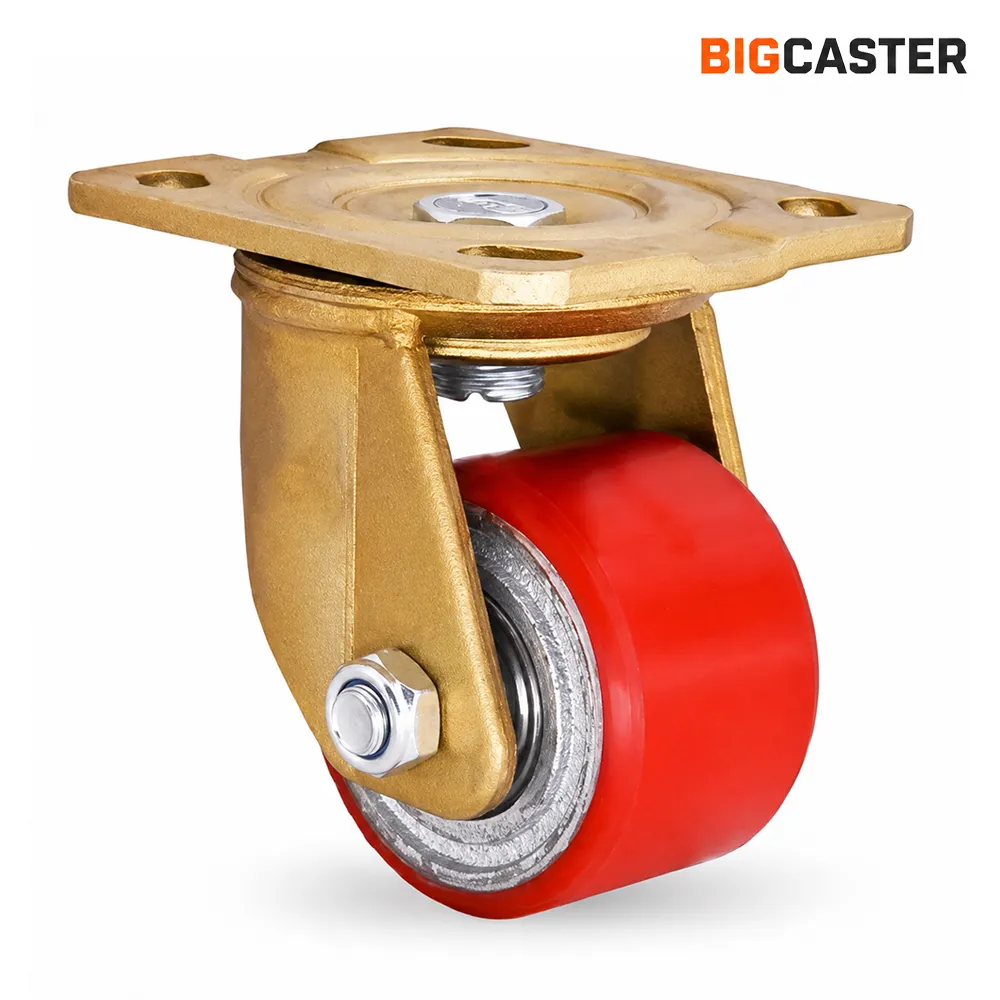
These characteristics make polyurethane a sensible starting point when the buyer wants both heavy-load performance and a resilient contact surface.
Polyurethane is not automatically the easiest material to push. A softer or thicker tread may deform more, increasing starting and rolling resistance. A harder compound may roll more efficiently but transmit more noise and shock. Wheel diameter, bearing type and floor condition still matter.
Polyurethane is a family of materials
A purchasing specification that says only “PU wheel” is incomplete. Important variables include:
- Tread hardness
- Tread thickness
- Polyurethane chemistry and formulation
- Wheel diameter and width
- Core material and geometry
- Tread-to-core bond system
- Casting or molding process
- Operating temperature
- Expected speed and duty cycle
- Exposure to water, oil or chemicals
Two polyurethane wheels with the same size and color can behave differently under load. Hardness alone does not describe tear strength, resilience, heat generation, compression, abrasion or hydrolysis resistance.
For wet or washdown service, ask whether the specific compound and bond are suitable for the water temperature, cleaning frequency and chemicals. For powered towing, ask for dynamic performance at the intended speed and continuous run time.
Iron-core vs steel-core polyurethane wheels
An extra heavy duty PU wheel commonly uses a cast iron or steel core. The core carries loads from the tread into the hub and bearings.
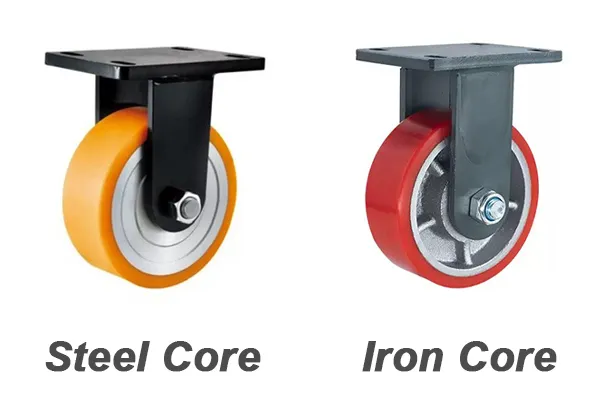
An iron core can provide a strong and economical foundation for many high-load wheels. A steel core may be selected when the project requires a fabricated, machined or forged structure with specific strength, impact or dimensional characteristics.
The core does not act alone. Its hub, bearing seats, webs, rim, surface preparation and bond to the polyurethane all influence the finished wheel. A stronger core cannot compensate for an unsuitable tread compound or weak bond.
Common polyurethane failure risks
Heat buildup
Polyurethane repeatedly deforms as the wheel enters and leaves the contact patch. During continuous movement, some of that energy becomes heat. Higher speed, longer travel, soft compounds, small diameter, heavy load and poor floors can increase thermal demand.
Excessive temperature can change tread properties, accelerate wear or weaken the tread-to-core bond. A static capacity rating does not establish suitability for continuous towing.
Tread cutting and chunking
Sharp metal debris, floor damage and excessive obstacle impact can cut or tear the tread. Small embedded objects can also create repeated stress as the wheel rotates.
Tread separation
Bond failure can result from heat, contamination during manufacturing, incompatible chemicals, water exposure, impact or forces beyond the intended duty. Examine both the compound and bond system when diagnosing separation.
Compression set and flat spotting
A resilient wheel may develop a temporary or lasting flat area after remaining heavily loaded in one position. Compound, load, temperature and parking time affect the result.
Best applications for polyurethane
Polyurethane is often suitable for:
- Smooth industrial concrete
- Coated or floor-sensitive surfaces
- Heavy machinery moved manually or at controlled speed
- Equipment requiring lower noise than metal wheels
- Factory platforms and carts
- Applications where some vibration isolation is desirable
- Projects needing a balance between capacity and floor preservation
BigCaster’s E0701 iron-core polyurethane caster is one example of a single-wheel extra heavy duty PU direction. Product size and rating must be matched to the application.
When polyurethane may not be the best choice
Consider another material or a specially engineered compound when the application involves:
- Temperature beyond the verified PU range
- Continuous cutting by sharp metal chips
- Chemicals incompatible with the tread or bond
- Extremely low deformation requirements
- High-speed or long-distance travel without dynamic validation
- Severe floor impact that repeatedly damages resilient treads
2. PA Nylon Wheels for Heavy Industrial Equipment
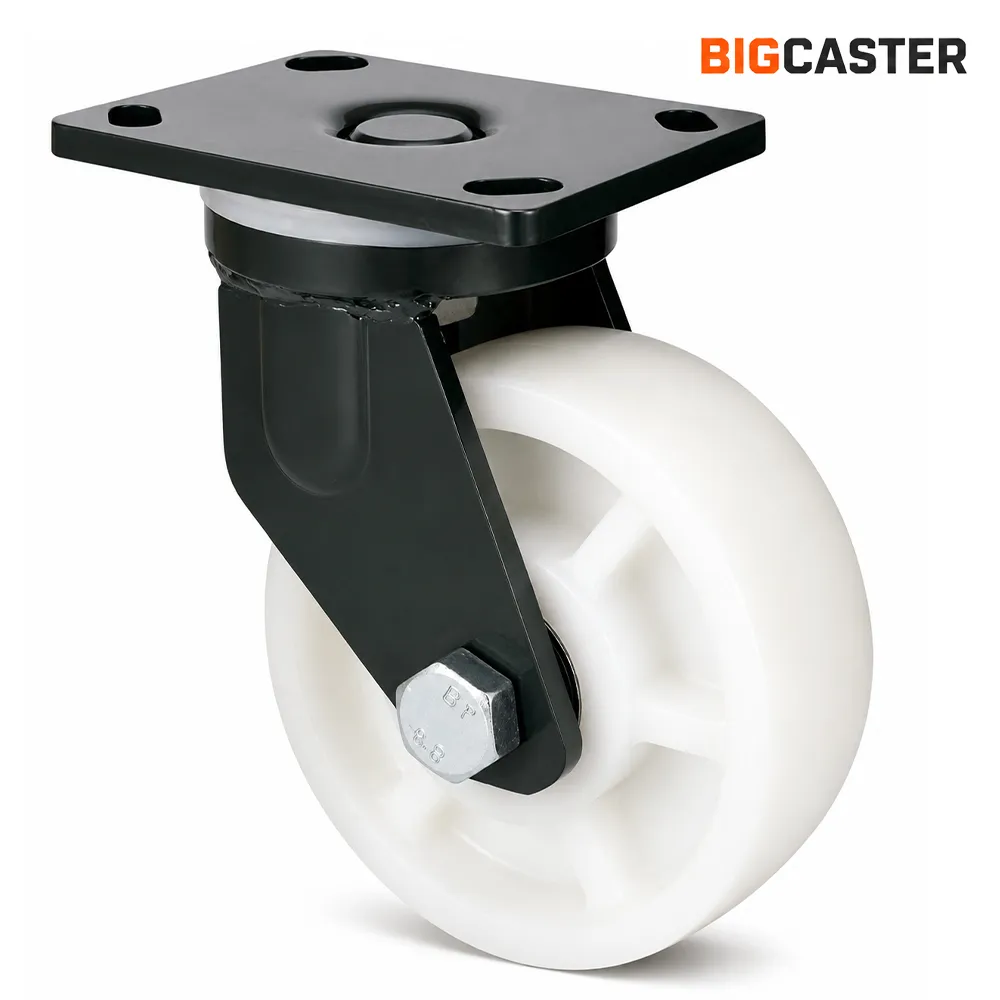
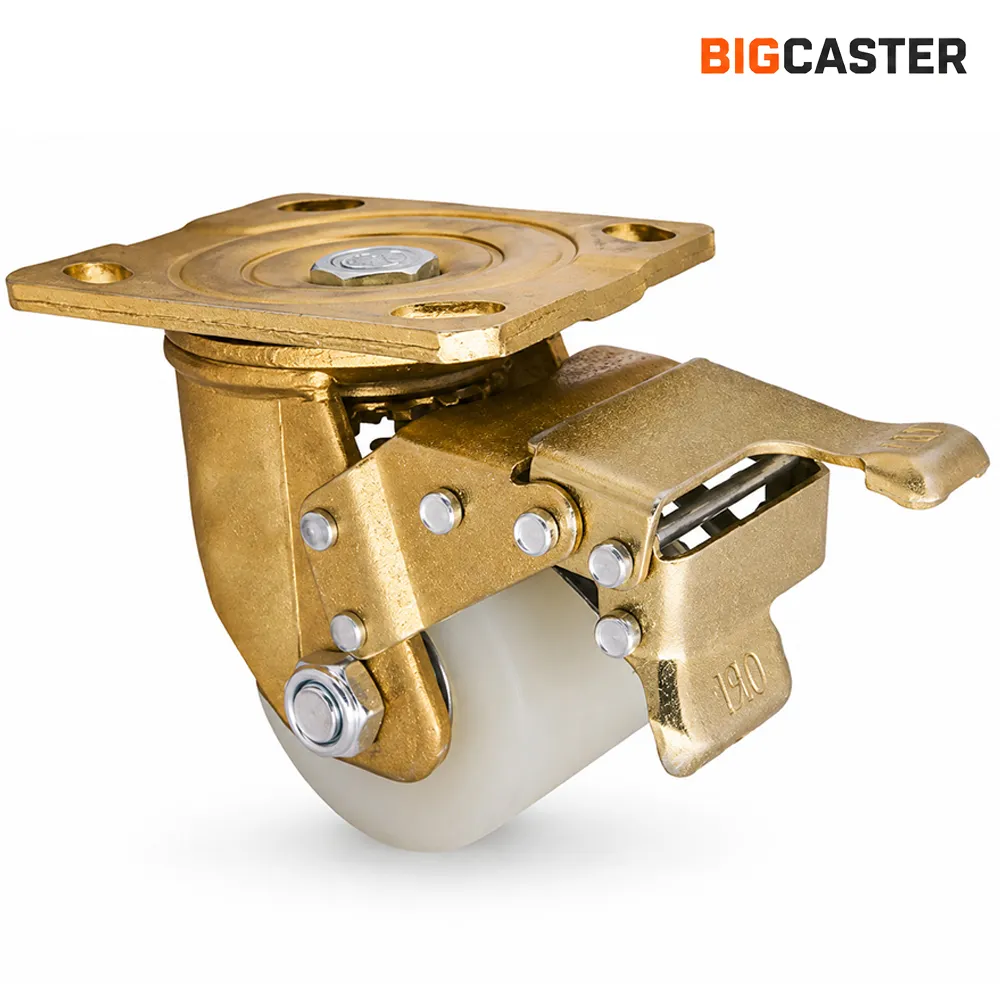
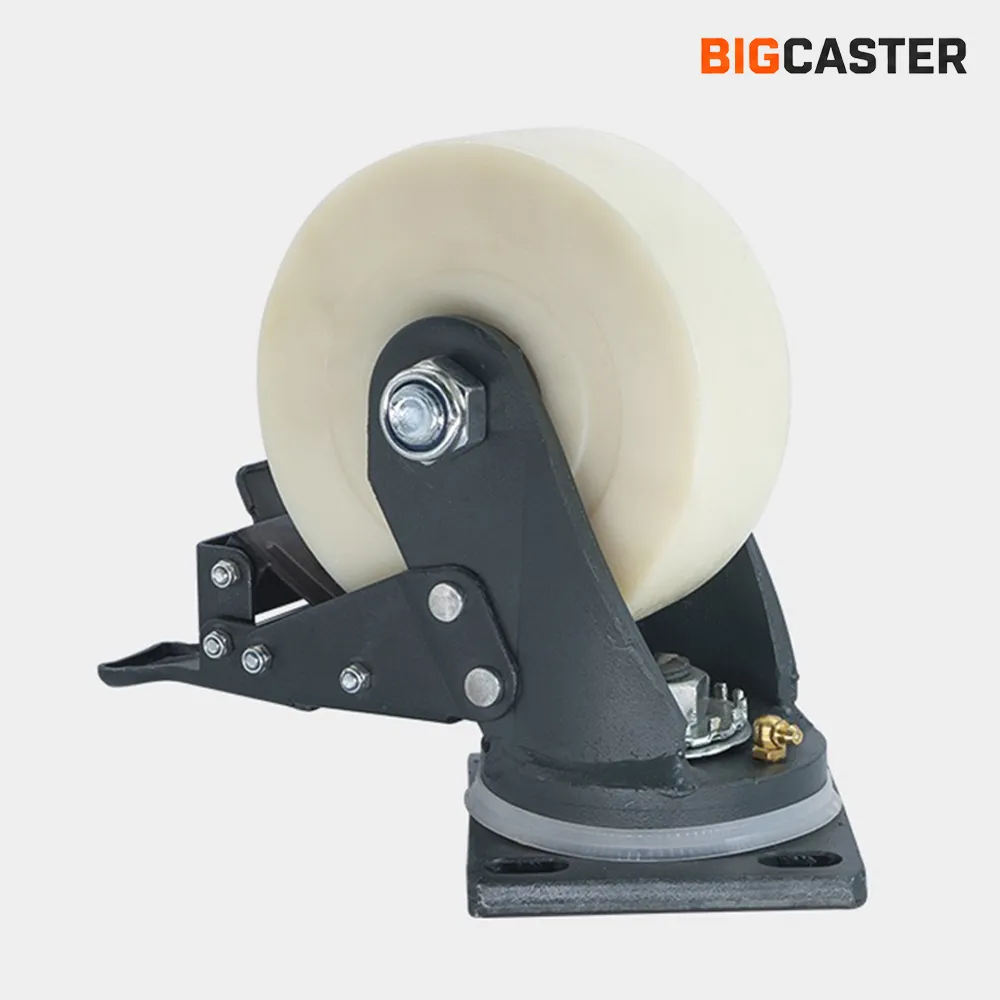
PA nylon wheels are hard, non-metallic wheels that can provide high load capacity and efficient rolling on smooth floors. BigCaster groups PA and MC nylon products within its nylon caster range, but buyers should identify the exact nylon type rather than treating every product as equivalent.
Main advantages of PA nylon
PA nylon can offer:
- Low tread deformation under load
- Relatively low rolling resistance on smooth, hard floors
- Good wear performance in suitable conditions
- No bare-metal rust at the wheel contact surface
- Easy cleaning
- Non-marking performance in many formulations
- Resistance to many common oils, greases and chemicals, subject to exact compatibility
Because it is harder than rubber and most polyurethane treads, PA nylon does not absorb as much energy through deformation. This can make a loaded cart feel more direct on a good floor.
Main limitations of PA nylon
The same hardness creates trade-offs:
- Less cushioning at joints and obstacles
- More vibration transmitted into the equipment
- Higher operating noise than resilient treads
- Increased local floor stress compared with a deformable tread
- Possible damage to weak or sensitive floor coatings
- Material behavior influenced by moisture, temperature and exact formulation
Do not describe nylon as universally chemical-proof. Compatibility depends on the exact polymer grade, substance, concentration, temperature and exposure time.
Best applications for PA nylon
PA nylon is a useful direction for:
- Smooth, clean industrial floors
- Low-speed equipment
- Applications prioritizing low deformation
- Washable or corrosion-conscious environments, with suitable bearings and brackets
- Equipment where some noise and shock are acceptable
- Heavy loads that do not require the extreme capacity or size of a specialized MC nylon wheel
It is less attractive when the route contains severe joints, loose debris or broken concrete, unless wheel diameter and travel speed are adjusted accordingly.
3. MC Nylon Wheels for Extra Heavy Loads
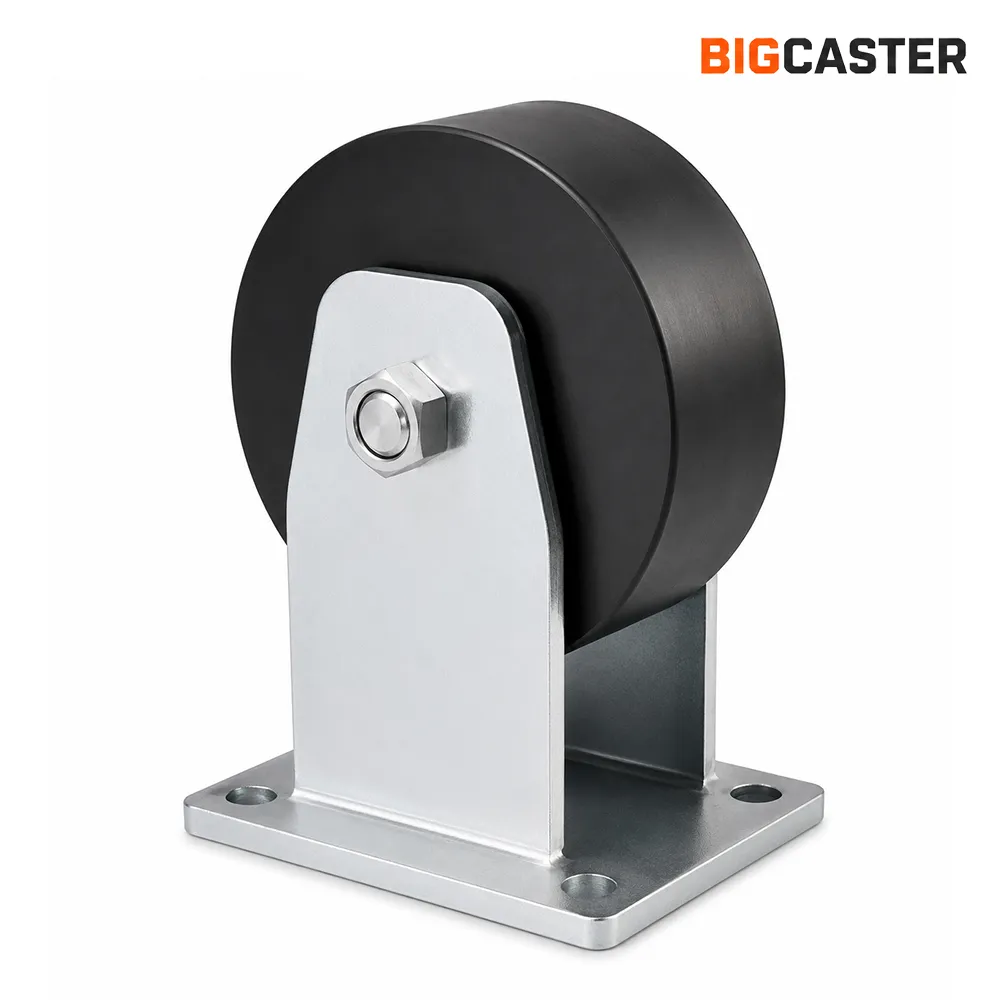
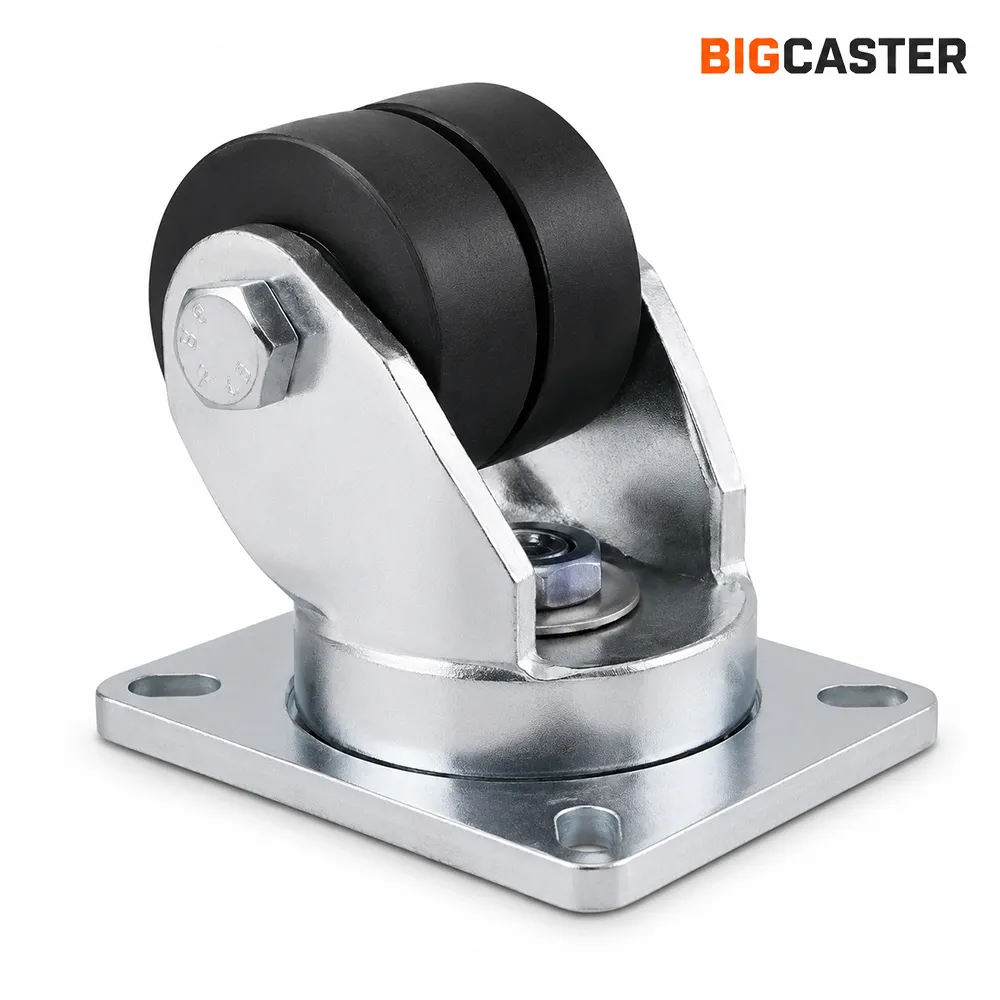
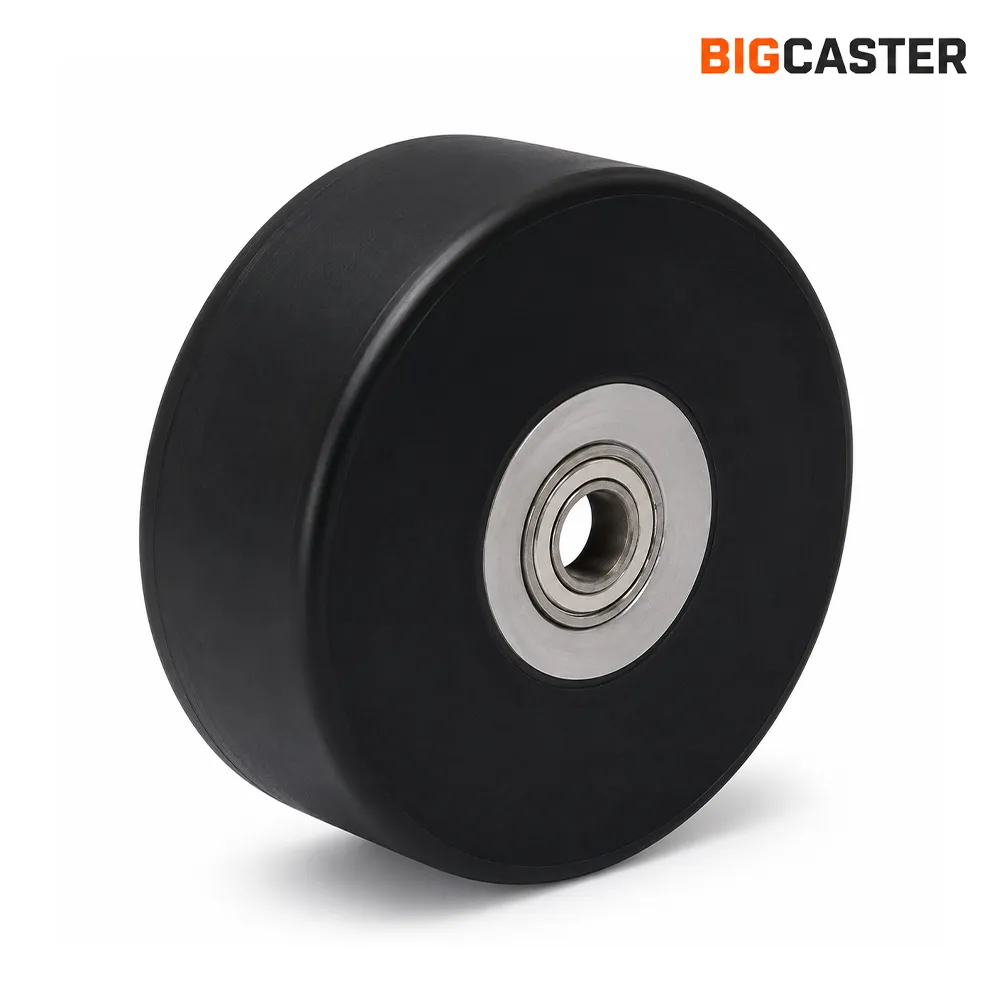
MC nylon generally refers to monomer-cast nylon used to produce substantial industrial components and wheels. The casting process can support larger wheel sections and specialized formulations, making MC nylon a common high-capacity hard-wheel direction.
PA nylon vs MC nylon caster wheels
| Factor | PA nylon | MC nylon |
|---|---|---|
| Typical manufacturing direction | Often injection-molded or machined from suitable stock | Commonly monomer-cast and machined as required |
| Typical application range | General heavy industrial wheels | Larger, extra heavy duty and low-deformation wheels |
| Load potential | High in suitable designs | Often higher in large, purpose-built designs |
| Tooling and customization | Depends on size and molding tooling | Can be practical for selected large or custom parts |
| Relative cost | Often lower for standard production | Often higher due to material and processing |
| Ride behavior | Hard, low cushioning | Hard, low cushioning |
This table describes common manufacturing directions, not a universal material hierarchy. A well-designed PA nylon wheel can outperform an unsuitable MC nylon wheel. Grade, additives, section size, bearings and the complete caster structure determine actual performance.
Why MC nylon is used for very heavy equipment
Potential advantages include:
- High load capability in suitable wheel dimensions
- Low compression under load
- Lower wheel weight than comparable metal constructions in many cases
- No rust at the wheel body
- Efficient rolling on smooth floors
- Availability in large diameters and widths
- Single- and dual-wheel options
The BigCaster E0601 MC nylon caster demonstrates that a single hard nylon wheel can support a multi-ton load range, depending on diameter and configuration.
Limitations of MC nylon
MC nylon remains a hard material. It provides limited vibration absorption, may be noisy and can transfer joint impact into bearings, swivels and equipment frames. High contact pressure must be checked on concrete and coated floors.
Temperature, moisture absorption, dimensional stability and chemical compatibility must be confirmed for the actual grade. Do not reuse a material limit taken from another manufacturer’s compound.
Best applications for MC nylon
MC nylon is often considered for:
- Multi-ton machinery
- Smooth, strong industrial floors
- Low-speed heavy equipment
- Low-deformation requirements
- Large single wheels
- Compact or dual-wheel high-capacity assemblies
- Applications where steel-wheel noise, corrosion or weight are undesirable
4. Cast Iron Wheels for Heavy Loads
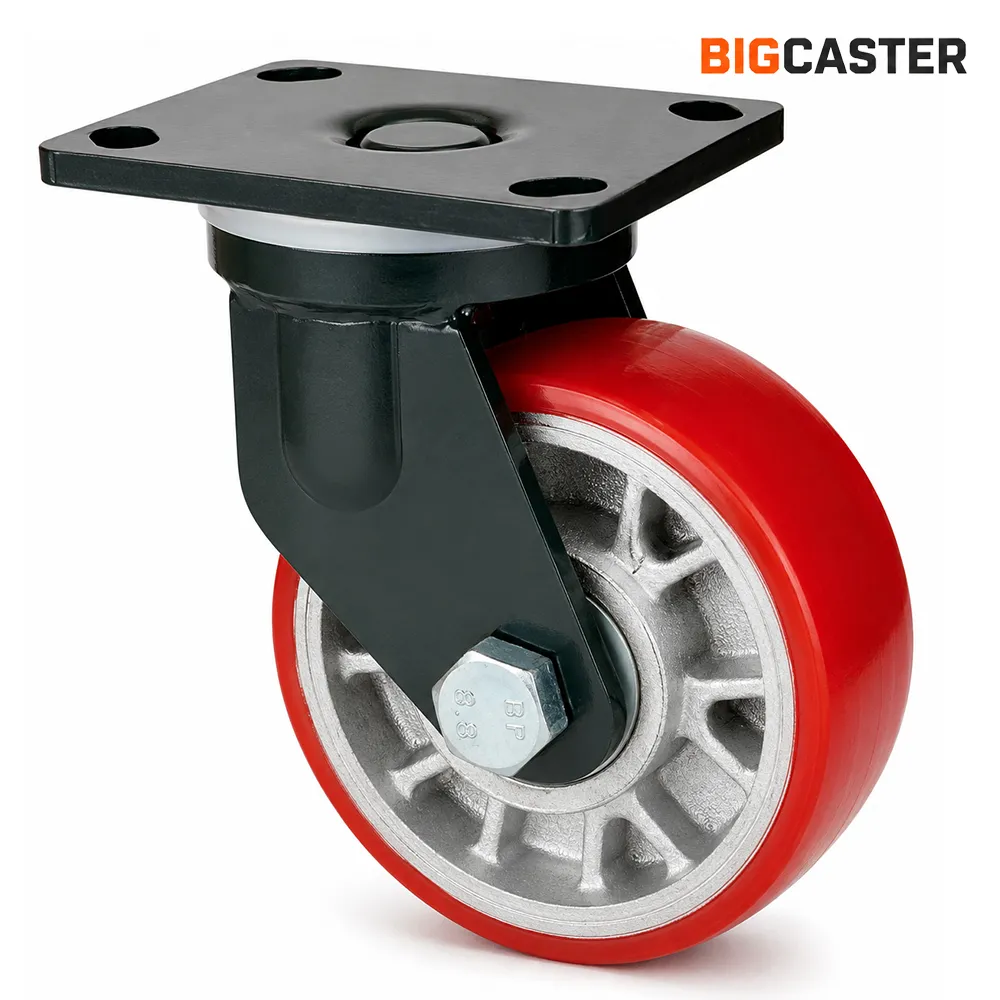
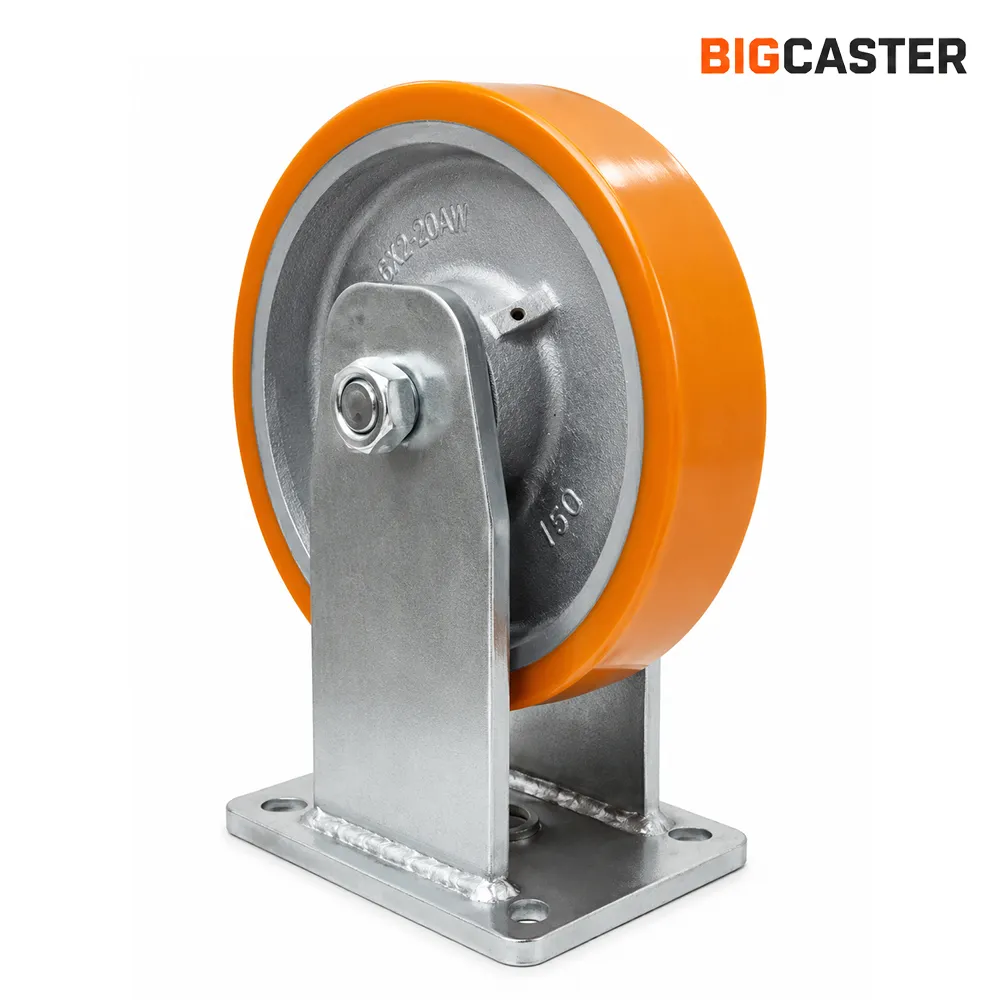
Cast iron caster wheels are hard wheels with low tread deformation and direct rolling behavior on suitable floors. They can be useful in slow-moving industrial service where floor protection and noise are less important than wear, temperature or resistance to certain debris.
Advantages of cast iron wheels
- High compressive load potential in a properly designed wheel
- Low deformation under static load
- Good wear performance on hard, smooth surfaces
- No resilient tread to cut, chunk or separate
- Potential suitability for temperature conditions beyond common elastomer limits
- Direct rolling on clean, level floors
- Resistance to some sharp debris that could cut PU or rubber
Limitations of cast iron wheels
Cast iron is not a floor-friendly material. A heavily loaded wheel can create high local stress and may mark, chip or damage concrete and coatings. It produces little cushioning, so joints and debris create impact loads in the wheel, bearings, caster rig and equipment.
Other concerns include:
- High operating noise
- Corrosion in wet environments
- Potential brittle fracture under unsuitable shock or defect conditions
- Increased vibration
- Poor performance on fragile floors
- Need for controlled speed and route quality
Do not select cast iron solely because it is harder than polyurethane. The floor and complete load path must be able to accept the resulting contact and impact forces.
Best applications for cast iron
Cast iron may be suitable when:
- Movement is slow and controlled
- The floor is hard, strong and relatively smooth
- Some noise and vibration are acceptable
- Metal chips or abrasive conditions would cut softer treads
- The operating temperature exceeds the verified range of available elastomers
- Floor preservation is secondary to mechanical durability
The caster’s bearings, grease, finish and mounting structure still need environmental validation.
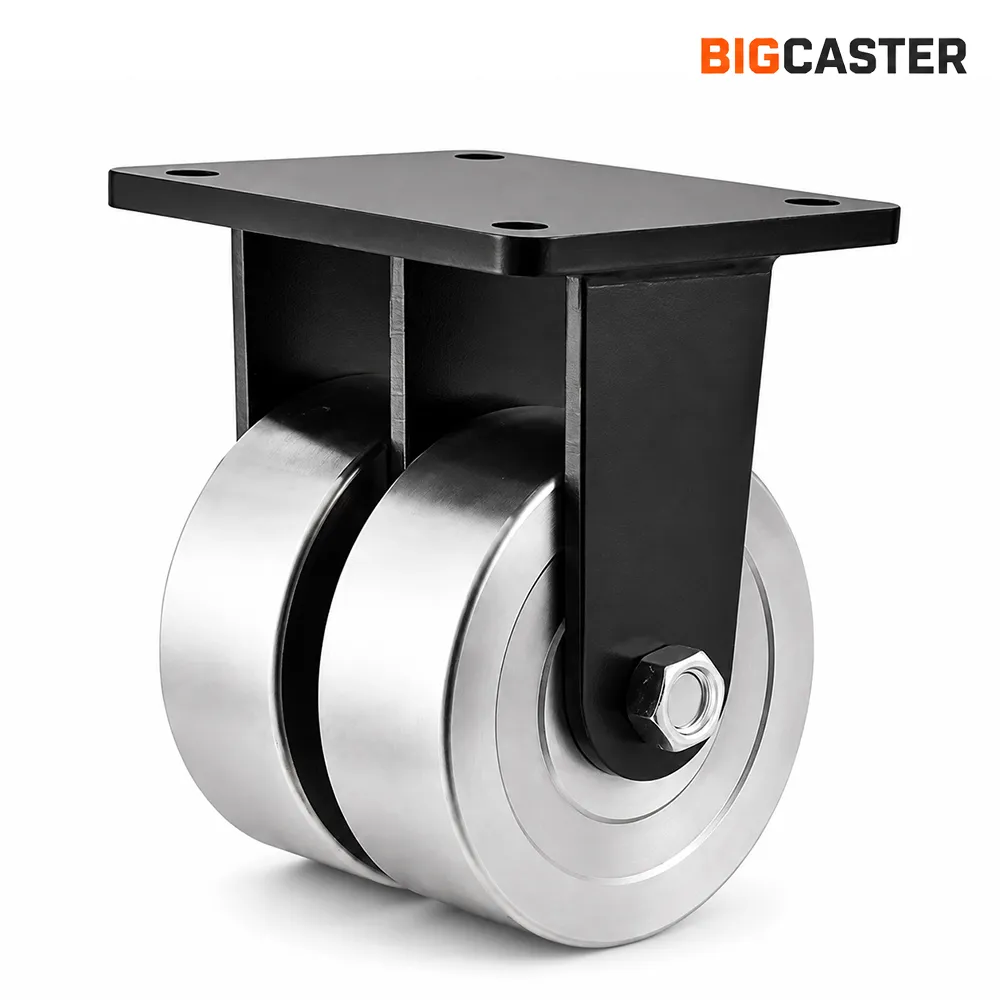
5. Steel Wheels for Extremely Heavy Equipment
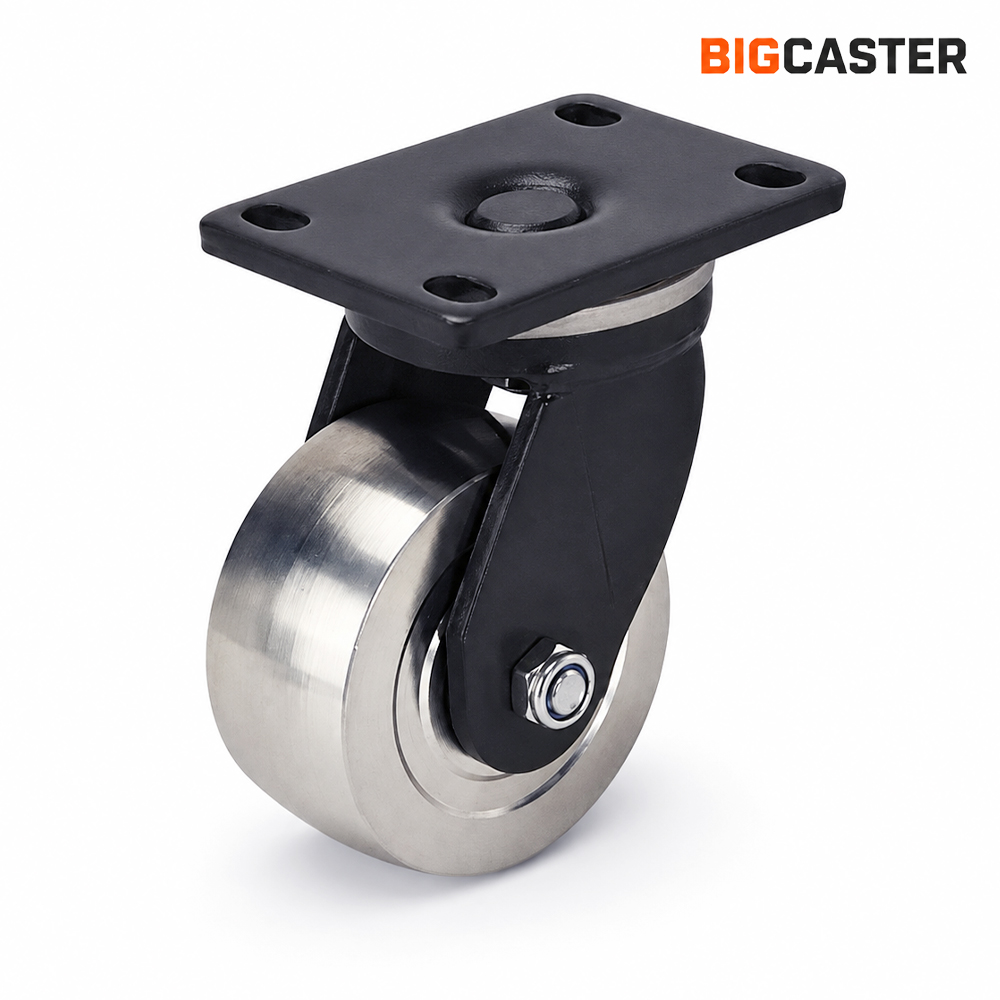
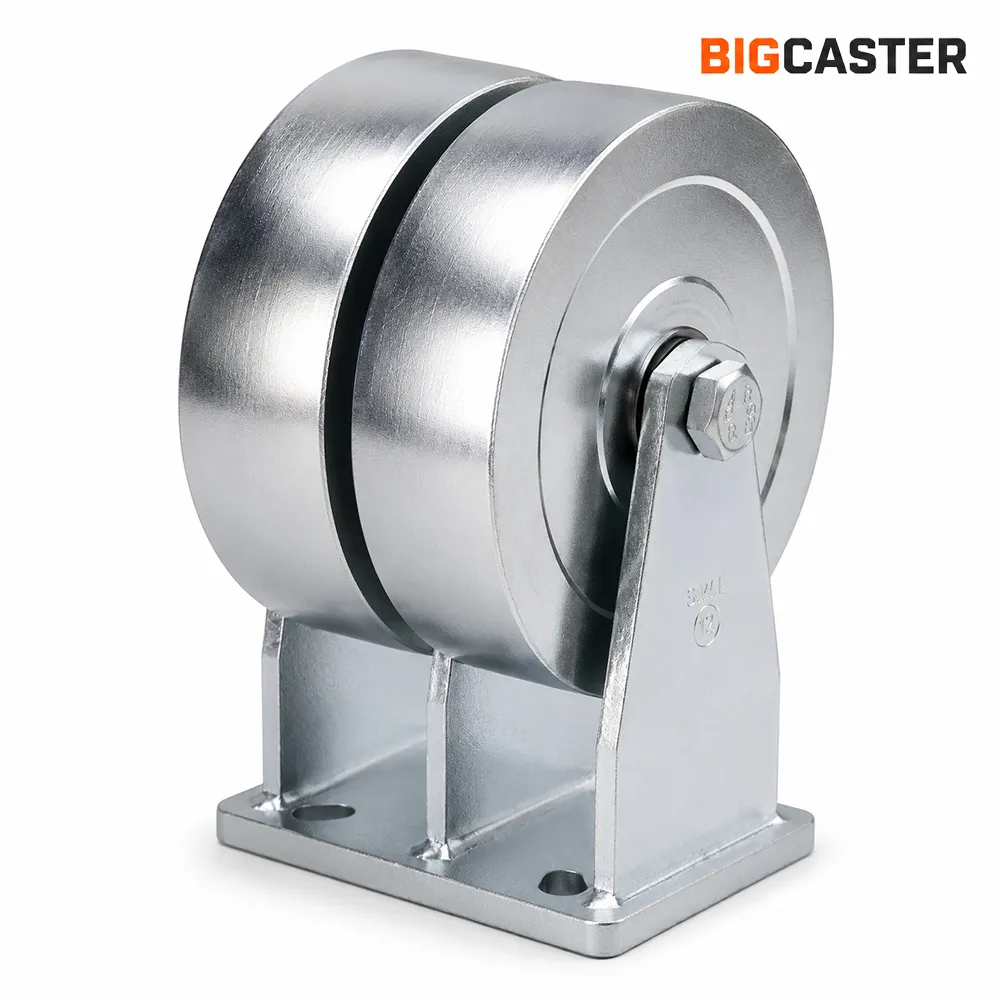
All-steel caster wheels are used when exceptionally high load potential, low material deformation or severe mechanical service outweigh the need for quiet movement and floor protection.
Why steel is selected
A purpose-designed steel wheel can provide:
- Very high structural capacity
- Minimal tread compression
- Strong resistance to cutting or chunking
- Robust performance in demanding mechanical environments
- High-impact toughness when the grade, processing and design are appropriate
- Suitability for some elevated-temperature conditions
- Single- or dual-wheel high-capacity construction
BigCaster’s E0301 dual-wheel steel caster is an example of a steel configuration intended for exceptionally high load ranges. It must be used on a compatible floor and under reviewed operating conditions.
Major steel-wheel trade-offs
Steel has essentially no tread cushioning. It transmits floor impact and vibration directly into the axle, bearings, fork, mounting plate and equipment. On ordinary concrete, high local pressure may crack, chip or spall the surface. The wheel can also be very noisy.
Other points to verify include:
- Steel grade and heat treatment
- Wheel hardness relative to the floor or rail
- Corrosion protection
- Bearing arrangement
- Axle and hub fit
- Maximum impact and speed
- Continuous and peak temperature
- Lubricant and seal compatibility
- Route cleanliness
“Steel wheel” is not a complete engineering specification. Forged, machined, cast or fabricated designs can have different properties.
Best applications for steel wheels
Steel is a relevant direction for:
- Extremely heavy equipment
- Low-speed movement on strong industrial floors
- Metalworking and severe debris environments
- Selected high-temperature applications
- Installations where resilient treads deform or fail
- Rail, V-groove or controlled-track systems designed for metal contact
- Equipment where noise and vibration are acceptable
6. Rubber Wheels: Are They Suitable for Extra Heavy Duty Casters?
Rubber caster wheels are valued for cushioning, traction, quiet movement and floor protection. However, within a comparable wheel envelope, rubber often deforms more and provides lower practical load potential than hard polyurethane, nylon or metal alternatives.
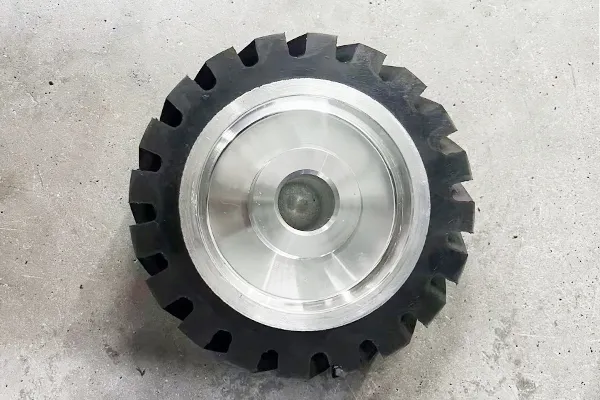
This does not mean rubber can never carry a large load. Heavy industrial rubber constructions exist, especially with steel or iron cores. The complete rating must be verified. In BigCaster’s current product range, the multi-ton extra heavy duty direction is primarily represented by polyurethane, PA or MC nylon and steel products rather than by ordinary rubber casters.
Advantages of rubber wheels
- Good vibration absorption
- Quiet travel
- Floor-friendly contact
- Useful grip
- Better ride over minor irregularities than a hard wheel of similar diameter
- Reduced transmission of high-frequency vibration into sensitive equipment
Limitations of rubber wheels
- Higher starting and rolling resistance in many applications
- Greater compression under load
- Risk of flat spotting during long stationary periods
- Heat generation during continuous travel
- Lower wear or cut resistance than selected polyurethane compounds
- Potential marking, aging or environmental degradation depending on formulation
- Limited extra-heavy capacity in many standard sizes
When rubber is a useful direction
Rubber may be considered when noise, cushioning and floor protection dominate and the required capacity is available from a verified wheel and caster construction. It is less suitable when the design requires the lowest possible deformation, a very low overall height or multi-ton capacity within a small diameter.
Polyurethane vs Nylon Caster Wheels
The choice between polyurethane and nylon is one of the most common industrial caster questions.
Polyurethane generally provides better cushioning, quieter travel and better protection for concrete coatings. Nylon generally deforms less and can roll more directly on a smooth, hard floor. Under the same load and diameter, the nylon wheel may transmit more vibration at joints, while the PU wheel may generate more heat during continuous deformation.
Choose polyurethane first when:
- Floor protection matters
- Noise must be reduced
- Minor vibration isolation is desirable
- The route is smooth to moderately imperfect
- A suitable dynamic rating is available
Choose PA or MC nylon first when:
- The floor is smooth and strong
- Low deformation is important
- Hard-wheel rolling is acceptable
- Noise and shock are not primary concerns
- Water or corrosion at the wheel body makes bare metal undesirable
The final decision should compare actual loaded starting force, continuous rolling force, floor contact and service temperature. Material names alone cannot predict ergonomic performance.
Polyurethane vs Steel Caster Wheels
Polyurethane and steel represent two different priorities.
PU prioritizes a balance of capacity, wear, floor protection and noise. Steel prioritizes low deformation and severe mechanical load capability. A steel wheel can survive conditions that cut or compress a resilient tread, but it may move the damage to the floor, bearings or frame.
Polyurethane is usually the better direction for normal factory concrete and manually moved equipment. Steel may be appropriate for exceptional loads, heat, metal debris, rail systems or conditions where an elastomer cannot survive.
Before replacing PU with steel, verify:
- Concrete or rail contact stress
- Equipment vibration tolerance
- Impact at joints
- Operator exposure to noise
- Swivel and bearing shock
- Stopping distance and control
Before replacing steel with PU, verify dynamic heat, tread bond, cutting exposure and the required capacity within the available size.
MC Nylon vs Steel Wheels
MC nylon and steel can both provide high load capability with low tread deformation. MC nylon may reduce wheel weight, avoid rust at the wheel body and provide less aggressive metal-to-floor contact. It still behaves as a hard wheel and offers little cushioning.
Steel may provide a better direction when severe impact, heat or concentrated mechanical forces exceed the verified capability of the nylon grade. It can also be suitable for purpose-built tracks.
MC nylon may be preferable when:
- The floor should not be exposed to bare steel contact
- Corrosion at the wheel body is a concern
- Lower wheel mass is useful
- Operating temperature and environment remain within the material limits
Steel may be preferable when:
- Extreme mechanical demand dominates
- The floor or track is engineered for metal wheels
- Temperature or cutting conditions rule out polymer wheels
- Noise and shock are acceptable
Use complete caster ratings, not material strength data alone.
Cast Iron vs Steel Caster Wheels
Cast iron and steel are often grouped together as “metal wheels,” but they are not interchangeable.
Steel generally offers better impact toughness when the grade and manufacturing process are correctly selected. Cast iron can provide good compressive performance and wear resistance but may be more vulnerable to brittle damage under severe shock.
Both materials:
- Are hard and low-deformation
- Create high floor contact stress
- Produce high noise
- Offer little or no cushioning
- Can corrode without suitable protection
- Require compatible bearings and lubricants
Choose between them by reviewing impact, temperature, floor or rail, corrosion, wheel design, manufacturing method and tested complete capacity. Do not use a generic rule such as “steel is always stronger” without comparing the actual products.
Rubber vs Polyurethane for Heavy Equipment
Rubber usually offers better cushioning and quieter movement. Polyurethane usually provides a better combination of load capacity, wear resistance and lower deformation for heavy industrial equipment.
Rubber is the stronger direction when sensitive equipment, noise or grip dominates and the load remains within a verified rating. PU is usually the stronger direction when the buyer needs higher capacity, longer wear or lower rolling resistance while retaining more floor protection than a metal or nylon wheel.
The decision should compare actual compounds. A hard industrial rubber and a soft polyurethane may not follow a simple category-level rule.
How to Choose Wheel Material by Operating Condition
Load capacity
Begin with the required rating per complete caster. Do not use wheel-material strength to calculate equipment capacity. The tread, core, hub, bearings, axle, fork, swivel section, mounting plate and frame all form the load path.
Uneven floors can reduce the number of casters supporting the equipment effectively. Shock, speed and duty cycle may require additional allowance or a different dynamic rating.
Starting and rolling resistance
Starting resistance is the force needed to begin movement. Continuous rolling resistance is the force required to keep the equipment moving. Tread deformation affects both, but so do wheel diameter, bearings, load and floor.
Hard nylon and metal wheels often deform less on smooth floors. Resilient PU and rubber wheels may absorb more energy but reduce noise and vibration. Larger diameters generally improve obstacle crossing and can reduce rolling effort.
Always test the complete loaded equipment when manual ergonomics matter.
Floor protection
A coated, tiled or weak concrete floor can eliminate an otherwise strong wheel material.
- Rubber generally provides the most cushioning and floor-friendly contact, subject to load and compound.
- PU often gives the best heavy-industrial balance between capacity and floor protection.
- Nylon is harder and may create greater local pressure.
- Cast iron and steel require a strong floor or designed track.
Debris changes this relationship. A hard object beneath even a resilient wheel can create a concentrated pressure point or become embedded in the tread.
Shock and vibration
Soft or resilient materials can absorb part of the disturbance from minor floor irregularities. They cannot fully compensate for small wheel diameter, excessive speed or large obstacles.
Hard wheels transfer more impact into the caster and equipment. This can shorten bearing, swivel, fastener or electronics life even if the wheel itself shows little wear.
For severe shock, consider route repair, larger wheels, lower speed or a spring-loaded caster rather than relying on material alone.
Temperature
Temperature limits apply to the entire caster. A metal wheel may tolerate heat that damages PU or rubber, while its grease, seals, bearings or bracket finish may still be unsuitable.
Specify:
- Normal ambient temperature
- Peak temperature
- Exposure duration
- Radiant or conducted heat
- Cooling period
- Travel speed under heat
Use product-specific limits. Do not apply a temperature value from one compound to another.
Chemicals, oil and water
Provide the exact substance, concentration, temperature, exposure time and contact method. A brief splash is different from continuous immersion or hot-pressure washdown.
Check compatibility for:
- Tread or wheel body
- Core
- Tread-to-core bond
- Bearings and seals
- Lubricant
- Axle and bracket finish
“Oil resistant” or “chemical resistant” without this context is not a complete specification.
Metal chips and debris
PU and rubber can be cut by sharp swarf. Nylon, cast iron and steel resist cutting better but may crush chips into the floor or transmit sharp impacts.
Also examine:
- Debris size and hardness
- Risk of wheel jamming
- Space between dual wheels
- Bearing sealing
- Guards and scrapers
- Cleaning frequency
Material selection should work with housekeeping controls, not replace them.
Speed and duty cycle
A caster rated for occasional manual movement may not be suitable for continuous powered towing. Repeated tread deformation generates heat, and higher speed increases the frequency and severity of impacts.
For powered movement, provide speed, distance, turns per shift, route and rest periods. Request the dynamic rating and inspect tread temperature, bond, bearings and wear during validation.
How Wheel Construction Changes Material Performance
Wheel diameter
A larger wheel generally crosses joints and debris more easily. This can allow a hard material to travel more smoothly or reduce the deformation demand placed on a resilient tread. Diameter does not change chemical or temperature compatibility.
Wheel width
A wider wheel may provide more material and a larger potential contact area, but it can also increase scrub during a swivel turn. Actual floor pressure depends on tread profile and deformation, not nominal width alone.
Single vs dual wheels
Dual wheels can package higher total capacity within a limited diameter or overall height. If the two wheels rotate independently, differential action may reduce the scrub produced while turning a wide resilient tread.
Dual construction does not change the base material’s resistance to heat, chemicals or cutting. It also adds bearings and spaces where debris can collect. The detailed trade-offs are explained in Single-Wheel vs Dual-Wheel Extra Heavy Duty Casters.
Wheel core
A PU or rubber tread may use an iron, steel, aluminum or polymer core. Extra heavy duty applications commonly need a high-strength metal core, but hub geometry and bearing support are as important as the material name.
Bearings
Low-deformation wheel material cannot compensate for undersized, contaminated or misaligned bearings. Bearing type, fit, seals, lubrication and axle design influence capacity, rolling resistance, speed and service life.
Best Wheel Material by Industrial Application
| Application | Initial material direction | Reason | Main verification |
|---|---|---|---|
| Manually moved machinery on smooth concrete | PU or nylon | Balance push force, noise and floor contact | Loaded starting and swivel force |
| Low-profile multi-ton mold cart | MC nylon, steel or high-capacity PU dual wheel | High capacity within limited height | Floor stress, heat, height and turning |
| Equipment on coated or epoxy floor | Suitable PU | More resilient contact than metal | Tread hardness, debris and contact pressure |
| Steel mill or hot metalworking area | Steel or cast iron direction | Heat, swarf and severe conditions | Exact temperature, impact, floor and bearings |
| Clean factory prioritizing low deformation | PA or MC nylon | Hard tread and direct rolling | Noise, joints, moisture and floor strength |
| Noise-sensitive heavy equipment | PU; rubber if capacity permits | Lower noise and better cushioning | Deformation, heat and complete rating |
| Equipment exposed to sharp chips | Steel, cast iron or selected hard nylon | Better cut resistance | Floor damage, jamming and impact |
| Outdoor or washdown equipment | Application-specific PU or nylon | Avoid bare wheel-body corrosion where possible | Water, hydrolysis, bearings and bracket finish |
| Powered towing | Purpose-validated compound | Dynamic heat and speed dominate | Rated speed, duty cycle and test results |
Worked Selection Examples
Example 1: Manually moved industrial machine
Conditions: The machine operates on smooth concrete, moves occasionally by hand, must remain relatively quiet and should not damage the floor.
Initial direction: Iron-core polyurethane.
PU provides a useful balance of heavy-load capability, floor protection and noise. The final design should use the largest practical diameter and a compound validated for the load.
Still required:
- Capacity per caster
- Tread hardness and thickness
- Loaded starting and sustained push force
- Swivel effort
- Floor-marking test
- Time parked under load
If push force is too high, a harder PU compound, larger wheel or nylon alternative may be evaluated. If the floor is sensitive, the harder alternative requires a new contact-pressure assessment.
Example 2: Low-profile mold cart
Conditions: The cart carries a multi-ton mold, moves slowly on strong concrete and has a strict deck-height limit.
Initial direction: MC nylon dual wheel, high-capacity PU dual wheel or steel dual wheel.
MC nylon can provide low deformation without bare-metal contact. PU may protect the floor and reduce noise but requires heat and compression review. Steel can deliver exceptional capacity but may damage the floor and transmit shock.
The structure comparison should follow the single- vs dual-wheel selection guide, while the material decision compares floor, steering, noise and maintenance.
Still required:
- Maximum overall height and total width
- Effective supporting caster count
- Floor compressive strength
- Turn frequency and loaded swivel force
- Joint dimensions
- Brake or directional-lock requirements
Example 3: Metalworking equipment exposed to chips and heat
Conditions: Slow movement, hot metal debris, hard industrial floor and no stringent noise limit.
Initial direction: Cast iron or steel.
A metal wheel avoids the cutting and tread-separation risks of an elastomer. Steel may provide a better impact direction; cast iron may be adequate for controlled low-speed service.
Still required:
- Continuous and peak temperature
- Chip size and accumulation
- Floor suitability
- Impact at joints
- Wheel grade and construction
- Bearing, seal and lubricant temperature limits
- Corrosion protection
If the equipment contains shock-sensitive components or the floor cannot accept metal contact, route control, larger diameter, spring loading or a specialized high-temperature resilient material may be needed.
12 Common Caster Wheel Material Selection Mistakes
- Choosing the material with the highest rating and calling it the best. Capacity does not describe floor protection, maneuverability or service life.
- Treating every polyurethane as the same. Hardness, formulation, thickness, core and bond can change performance substantially.
- Ignoring the polyurethane wheel core. The tread, core, hub and bearing support must work as one wheel.
- Assuming PA nylon and MC nylon are interchangeable. They may use different processes, grades and wheel-size strategies.
- Treating cast iron and steel as identical metal wheels. Impact behavior, manufacturing and structural properties differ.
- Assuming nylon resists every chemical. Compatibility must be checked against the exact substance and exposure.
- Selecting rubber only because the floor is rough. Wheel diameter, obstacle height and load may be more important, while rubber can deform substantially.
- Ignoring local floor pressure. Hard wheels can damage concrete or coatings even when they carry the equipment safely.
- Using static capacity to predict push force. Rolling and swivel behavior require separate evaluation.
- Ignoring dynamic heat. Continuous travel can overheat a resilient tread or bearing system.
- Using wheel material to represent the complete caster rating. Forks, swivels, axles and mounting plates also limit capacity.
- Skipping a loaded route test. Real floors reveal impact, noise, steering, heat and marking that a material table cannot.
Wheel Material Specification Checklist
| Required information | Project requirement |
|---|---|
| Equipment description | |
| Empty equipment weight | |
| Maximum payload | |
| Required capacity per caster | |
| Effective supporting caster count | |
| Manual, powered or towed movement | |
| Normal and maximum speed | |
| Travel distance and frequency | |
| Floor material and condition | |
| Largest joints, gaps or obstacles | |
| Floor-protection requirement | |
| Maximum acceptable noise | |
| Wheel diameter and width | |
| Maximum overall caster height | |
| Single- or dual-wheel structure | |
| Preferred wheel material | |
| Required tread hardness | |
| Wheel-core material | |
| Minimum and maximum temperature | |
| Water or washdown exposure | |
| Chemicals, concentration and contact time | |
| Metal chips, fibers or other debris | |
| Wheel-bearing requirement | |
| Swivel or rigid configuration | |
| Brake or directional-control requirement | |
| Required samples and testing |
Information to Send BigCaster
When requesting a material recommendation, send more than the desired wheel type. Include:
- Maximum loaded equipment weight
- Number and position of casters
- Center-of-gravity or unequal-load information
- Manual, powered or towed movement
- Maximum speed, travel distance and cycles
- Floor description and route photographs
- Joint and obstacle dimensions
- Maximum wheel diameter, width and caster height
- Temperature and exposure time
- Water, chemicals, oils and cleaning process
- Metal chips or other debris
- Noise, vibration and floor-protection priorities
- Single- or dual-wheel preference
- Mounting dimensions
- Current wheel failure, if replacing an existing design
- Quantity and project schedule
BigCaster can compare PU, PA nylon, MC nylon, cast iron and all-steel options within its extra heavy duty caster range. Custom load capacity, dimensions and configurations can also be reviewed against the application data.
Frequently Asked Questions
What is the best caster wheel material for extremely heavy loads?
There is no single best material. Polyurethane is often the best all-around direction when floor protection and noise matter. MC nylon can provide high capacity with low deformation on smooth floors. Steel or cast iron may suit exceptional mechanical, heat or debris conditions. Compare the complete caster rating and real operating environment.
Is polyurethane or nylon better for heavy duty casters?
Polyurethane generally protects floors and reduces noise better. Nylon generally deforms less and can roll efficiently on smooth, hard floors. Choose by load, floor, movement, noise, joints, speed and environment rather than material name alone.
What is the difference between PA nylon and MC nylon wheels?
PA nylon wheels are commonly produced through molding or machining from appropriate material, while MC nylon is commonly monomer-cast and used for substantial industrial wheels. MC nylon often supports large, high-capacity designs, but exact properties depend on grade and construction.
Are steel caster wheels stronger than nylon wheels?
Steel has very high strength potential, but the complete wheel and caster determine capacity. A large MC nylon wheel can carry a greater rated load than a smaller or poorly designed steel wheel. Steel also creates more floor stress, noise and shock.
Do steel and cast iron wheels damage concrete floors?
They can. Hard metal wheels create high local contact pressure and may mark, chip or spall concrete, especially under impact or on weak surfaces. Review floor strength, wheel diameter, width, load and route before using them.
Are polyurethane wheels suitable for powered towing?
They can be when the compound, tread, core, bond, bearings and complete caster are rated for the required speed and duty cycle. Static or manual-movement capacity does not confirm towing suitability because repeated deformation can generate heat.
Which caster wheel material has the lowest rolling resistance?
Hard materials such as nylon or steel often deform less on smooth floors, but rolling resistance also depends on wheel diameter, bearings, load, alignment and floor. The lowest material deformation does not guarantee the lowest force for the complete equipment.
What wheel material is best for rough floors?
Material alone cannot solve a rough route. A resilient PU or rubber tread may absorb minor irregularities, while a larger wheel crosses obstacles more effectively. Severe floors may require route repair, larger diameter, lower speed or spring-loaded casters.
Can rubber wheels be used for extra heavy duty casters?
Yes, if a complete rubber-wheel caster is rated for the required load and duty. Rubber usually offers better cushioning but more deformation and rolling resistance than PU, nylon or metal. Verify capacity, flat spotting, heat and service life.
Final Material Selection Principle
The best wheel material for heavy loads is the one that balances capacity, movement, floor and environment for the actual equipment.
Use this decision sequence:
- Calculate the required capacity per complete caster.
- Define manual, powered or towed movement.
- Inspect the floor, joints, obstacles and debris.
- Establish acceptable starting, rolling and swivel force.
- Define noise, vibration and floor-protection requirements.
- Document temperature, water and chemicals.
- Select wheel diameter, width, core and single- or dual-wheel construction.
- Compare suitable material directions.
- Confirm product-specific ratings and compatibility.
- Validate the final wheel on representative equipment and the real route.
Choose polyurethane when a resilient, floor-conscious industrial balance is required. Choose PA or MC nylon when hard-wheel rolling and low deformation suit the floor. Choose cast iron or steel when extreme mechanical or environmental conditions justify their noise, shock and floor impact. Choose rubber when cushioning is the priority and a verified capacity is available.
The material decision is complete only when the wheel, bearings, caster rig, mounting structure and equipment operate safely as one system.