

Heavy duty casters and extra heavy duty casters are both designed to move industrial loads, but the difference is not simply a higher number printed in a catalog. Extra heavy duty casters generally occupy the higher-capacity and more demanding end of a manufacturer’s range. They may use larger swivel sections, thicker structural components, stronger wheel hubs, wider or dual wheels, and bearing systems selected for concentrated loads and severe service.
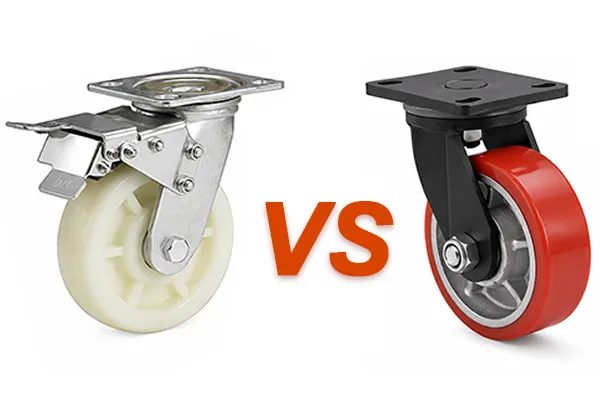
There is no universal load threshold that separates the two categories across every manufacturer. A caster described as extra heavy duty by one supplier may fall within another supplier’s heavy duty range. Buyers therefore need to compare the complete assembly and its rating conditions—not just the duty label.
This guide explains the practical differences between heavy duty and extra heavy duty caster wheels, when each type makes sense, and what information an equipment manufacturer or industrial buyer should provide before requesting a recommendation.
Heavy Duty vs Extra Heavy Duty Casters at a Glance
| Comparison | Heavy Duty Casters | Extra Heavy Duty Casters |
|---|---|---|
| Primary role | General industrial mobility under substantial loads | Multi-ton, concentrated-load or especially demanding industrial movement |
| Load classification | Varies by manufacturer and series | Normally the higher-capacity class within the same manufacturer’s range |
| Caster rig | Reinforced industrial construction | Larger, thicker, forged, welded or specially reinforced construction, depending on design |
| Swivel section | Industrial raceway or bearing system | Often a larger bearing area or higher-capacity swivel design |
| Wheel arrangement | Single wheels are common | Wide single wheels and dual-wheel configurations are more common |
| Operating conditions | Controlled industrial floors and ordinary duty cycles | Higher shock, more severe duty cycles or concentrated loads |
| Maneuverability | Often easier to configure for manually moved carts | Requires closer attention to rolling and swivel resistance |
| Typical applications | Platform carts, material-handling equipment, mobile workstations and production equipment | Large machinery, tooling platforms, mold carts, container-handling systems and heavy mobile structures |
| Initial cost | Usually lower | Usually higher because of increased material, machining and bearing requirements |
The important phrase in this comparison is within the same manufacturer’s range. Duty labels are useful for navigating a product line, but they should not replace an application review.
What Are Heavy Duty Casters?
Heavy duty casters are industrial caster assemblies designed to carry substantial loads while providing the mobility, steering and durability required by factory and material-handling equipment. Common applications include industrial carts, production fixtures, mobile machinery, logistics equipment and heavy workstations.
A typical heavy duty caster may include:
- A reinforced steel top plate and fork
- An industrial swivel raceway or rigid fork
- A larger axle than light-duty or general-purpose casters
- A polyurethane, rubber, nylon, cast iron or steel wheel
- Roller, ball or other industrial wheel bearings
- Optional wheel brakes, total locks or directional locks
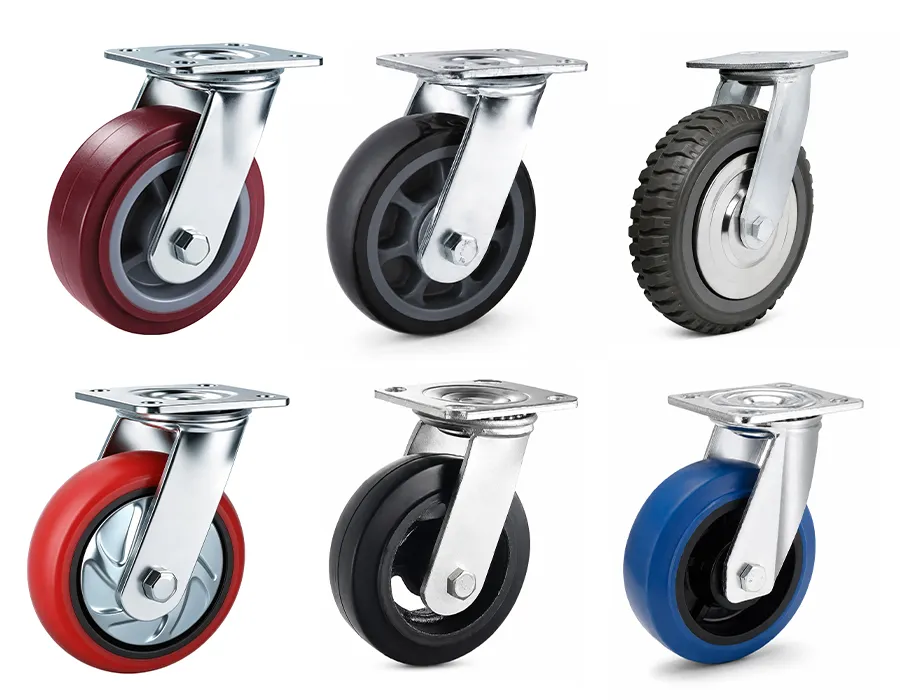
The term does not identify one construction method or one fixed capacity range. Wheel diameter, tread width, hub construction, bearing type, caster rig design and test conditions all affect the final rating. A 6-inch polyurethane caster and a 10-inch forged steel caster can both be sold as heavy duty while serving very different equipment.
For buyers comparing general product types, materials, sizes and load options, the BigCaster heavy duty caster range is the main commercial product hub.
What Are Extra Heavy Duty Casters?
Extra heavy duty casters are designed for applications at the upper end of industrial caster performance. They are commonly considered when a machine, platform or cart places unusually high concentrated loads on each mounting position, or when operating conditions create stress beyond what a standard heavy duty assembly is intended to handle.
Depending on the series and application, an extra heavy duty caster may use:
- A thicker or larger mounting plate
- Wider fork legs or welded structural reinforcement
- A forged or heavily machined swivel section
- A larger swivel bearing area
- A stronger kingpin or a kingpinless design
- A larger axle and more substantial wheel bearings
- A wide single wheel or dual-wheel configuration
- An iron-core polyurethane, MC nylon, cast iron or all-steel wheel
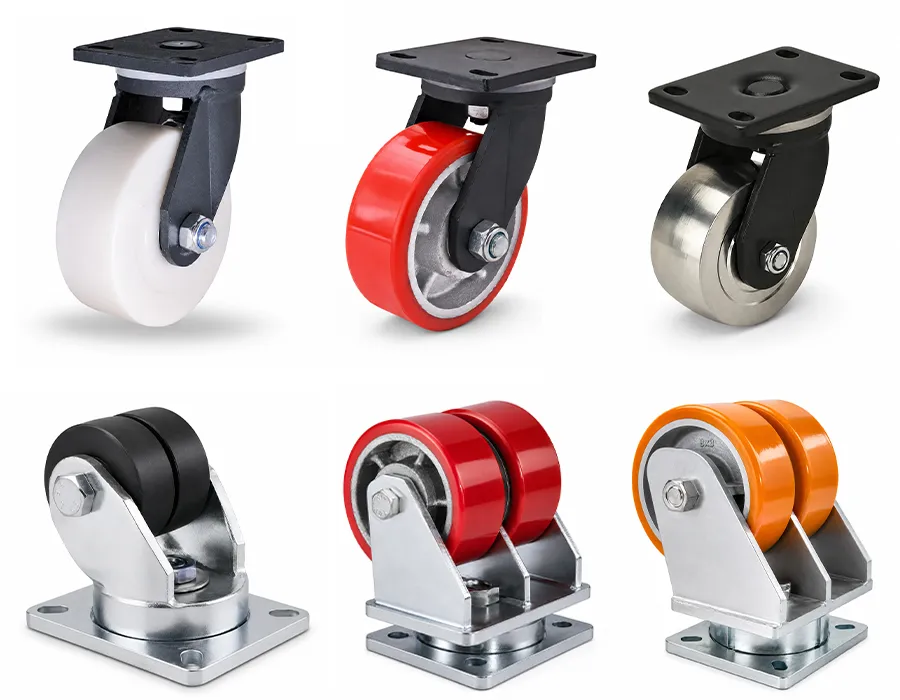
The purpose of these changes is not only to increase the headline load rating. They can also improve resistance to structural deformation, side loading, shock, repeated swiveling and demanding duty cycles. However, every design has trade-offs. A larger caster may need more mounting space, create a greater turning envelope or require more effort to swivel if the wheel and bearing system are poorly matched to the application.
BigCaster’s extra heavy duty caster range is intended for large machinery, heavy industrial platforms, container-handling equipment, construction applications and other projects where a stronger caster assembly is required.
Is There a Standard Load Capacity That Defines Extra Heavy Duty Casters?
No single capacity universally separates heavy duty from extra heavy duty casters.
Manufacturers divide their ranges differently. One company may start its extra heavy duty range at a capacity another company still describes as heavy duty. For example, Hamilton presents extra heavy duty series for applications around 4,000 to 10,000 pounds per caster, while Caster Concepts uses substantially different capacity bands in its own heavy, extra heavy and super heavy categories. These are product-family classifications, not a global grading system.
Capacity figures can also be based on different test conditions. A dynamic caster rating is established under defined parameters such as speed, test duration, obstacles and temperature. The rating should therefore be understood together with the manufacturer’s test basis and application limits.
When comparing products, ask:
- Is the published capacity static or dynamic?
- Is the value stated per caster or for a complete set?
- At what speed was the caster tested?
- Was the test performed on a smooth surface?
- Did the test include obstacles or impacts?
- Does continuous operation require derating?
- Are swivel and rigid versions rated equally?
- Does temperature or chemical exposure change the usable capacity?
The product label is only a starting point. The equipment’s loaded weight, effective supporting caster count and real operating conditions must still be reviewed. Buyers can use BigCaster’s caster wheel load capacity calculator for an initial estimate, followed by an application-specific check.
7 Key Differences Between Heavy Duty and Extra Heavy Duty Casters
1. Load Capacity and Rating Conditions
Extra heavy duty casters normally have a higher rated capacity than heavy duty casters within the same manufacturer’s product system. Yet capacity alone does not tell the full story.
The total loaded weight includes the equipment itself, the maximum payload, permanently installed accessories and any material that may be added during use. That total is then distributed among the caster mounting positions—but it may not be distributed equally.
On a rigid four-caster frame traveling over an uneven floor, one wheel can temporarily lose full contact while the other three support most of the weight. A high or offset center of gravity can further increase the load at one corner. Thresholds, floor joints, dropped loads, sudden stops and powered towing also produce dynamic forces that a simple static division does not capture.
Consequently, an extra heavy duty caster may be selected even when the nominal weight appears to fit a heavy duty model. Conversely, a carefully engineered heavy duty caster can be sufficient when the load is balanced, movement is slow, the floor is smooth and the duty cycle is controlled.
The correct comparison is not:
Which caster has the larger number?
It is:
Which caster has an appropriate tested capacity and construction for the actual load, movement and environment?
2. Caster Rig and Mounting Plate Construction
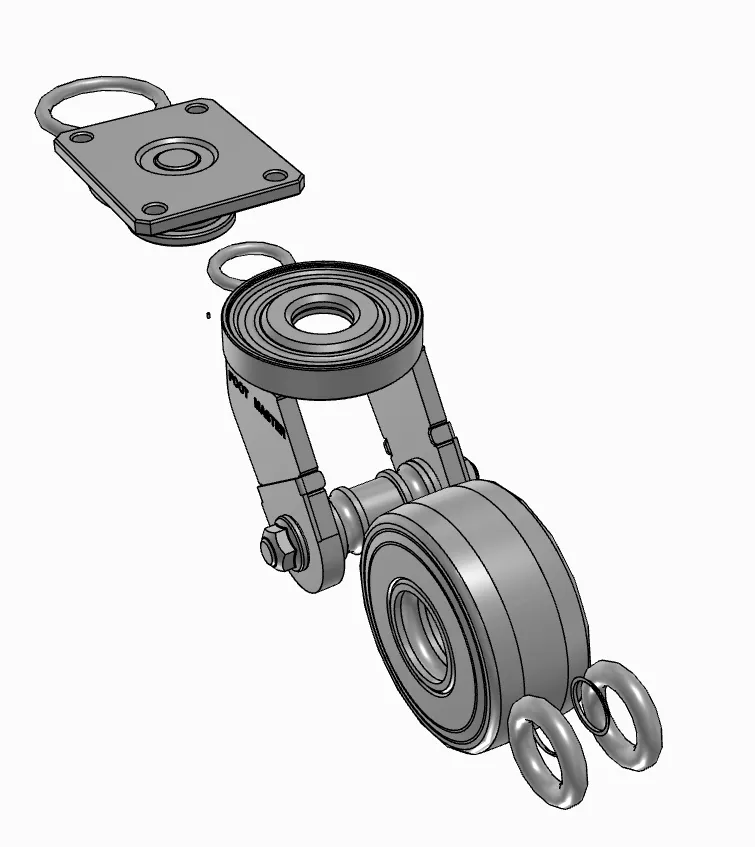
The caster rig transfers load from the equipment frame into the wheel. It includes the top plate, fork legs, swivel section and related structural parts. Under extreme load, small changes in plate thickness, material grade, forming, welding and geometry can significantly affect stiffness and service life.
Heavy duty caster rigs are already stronger than ordinary industrial caster frames. Extra heavy duty models may go further by using:
- Larger top plates that spread force over a wider mounting area
- Thicker plate material
- Wider or deeper fork legs
- Hot-forged, machined or welded swivel components
- Reinforcing ribs or continuously welded joints
- Greater clearance for wider wheels and larger axles
The equipment structure above the caster is equally important. Installing a high-capacity caster onto a thin, flexible base plate does not create a high-capacity system. The equipment frame can deflect, mounting bolts can loosen, or the plate around the bolt holes can deform before the caster reaches its catalog rating.
For a multi-ton project, the buyer should verify the caster top-plate dimensions, bolt-hole pattern, fastener grade, equipment mounting surface and reinforcement around each mounting position.
3. Swivel Section and Bearing System
The swivel section must support vertical load while allowing the fork and wheel to rotate around a vertical axis. As the load increases, friction, side force and deformation in this area can make a caster difficult to steer even if the wheel itself can carry the weight.
Heavy duty swivel casters may use ball raceways, thrust bearings or other industrial bearing arrangements. Extra heavy duty designs may use a larger raceway, precision-machined bearing surfaces, tapered roller bearings, an integrally forged kingpin, an enlarged kingpin or kingpinless construction.
No single swivel design is automatically best for every application. A kingpinless swivel can remove one traditional stress concentration and perform well under shock or frequent swiveling. A precision kingpin design can also provide excellent service when properly sized, adjusted and matched to the load. Manufacturing quality, material treatment, bearing size, swivel lead and maintenance all matter.
This is also why rated load and maneuverability must be evaluated separately. A swivel caster can support the required vertical load yet demand excessive steering force. For manually moved equipment, the effort required to start, roll and swivel the load can become the practical limiting factor before structural capacity is reached.
4. Wheel Material, Core and Tread
Both duty classes can use polyurethane, nylon, cast iron or steel wheels. Extra heavy duty performance does not come from one mandatory wheel material. It comes from matching the complete wheel—tread, core, hub, bearings, width and diameter—to the application.
Common directions include:
- Iron-core polyurethane: Combines a resilient tread with a strong metal core. It can provide a useful balance of capacity, floor protection, noise and rolling performance on suitable industrial floors. Buyers can review heavy duty polyurethane casters for available configurations.
- PA or MC nylon: Offers a hard, easy-rolling surface with good wear and chemical performance in many industrial environments. Hard nylon can transmit more vibration and noise than a resilient tread. See BigCaster’s heavy duty nylon caster range.
- Cast iron: Provides high load potential and wear resistance on strong, smooth floors, but can be noisy and may mark or damage some surfaces.
- All-steel or forged steel: Suitable for concentrated loads, impact or temperatures that exclude softer tread materials. Steel wheels generally require a strong floor and careful consideration of noise, vibration and floor pressure. Related options are available in the heavy duty steel caster range.
A harder wheel is not automatically a better extra heavy duty wheel. The right choice depends on whether capacity, low rolling resistance, impact absorption, floor protection, temperature or chemical resistance is the controlling requirement.
5. Wheel Diameter, Width and Dual-Wheel Design
Extra heavy duty casters frequently use larger-diameter, wider or dual-wheel arrangements, but each dimension changes more than capacity.
A larger wheel generally crosses joints and small obstacles more easily than a smaller wheel. It can also reduce the force required to keep a load rolling. The trade-offs are increased overall height, a larger swivel radius and more space around the equipment.
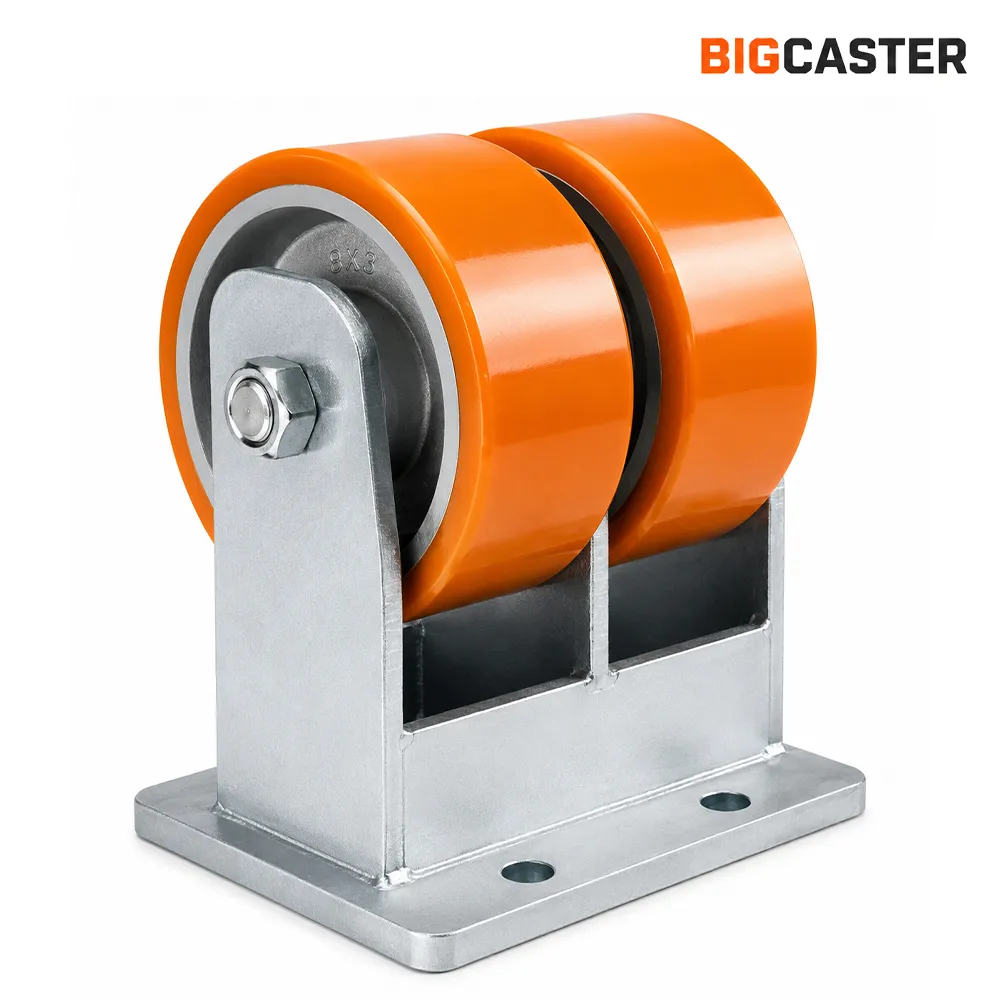
A wider wheel provides more material and a larger contact area, but it can also increase scrubbing resistance during a turn. On a stationary, heavily loaded swivel caster, a very wide single wheel may be difficult to rotate around its contact patch.
Dual-wheel casters place two wheels side by side. Their combined structure can support higher loads in a limited overall height. Because the two wheels can rotate at different speeds while swiveling, a properly designed dual-wheel assembly may also turn more easily than one extremely wide wheel. However, the capacity does not automatically double in every real installation. Axle design, wheel spacing, bearings, caster rig strength, floor contact and load distribution still need to be considered.
Therefore, single versus dual wheel should be treated as an engineering choice—not as the definition of heavy duty versus extra heavy duty.
6. Shock, Speed and Duty Cycle
A caster carrying a stationary machine experiences a different load from the same caster traveling across expansion joints for several hours per shift. This difference is central to choosing the correct duty class.
Shock can result from:
- Uneven concrete
- Dock plates
- Door thresholds
- Rails, gaps and expansion joints
- Debris on the travel path
- Dropped or suddenly applied loads
- Abrupt towing, braking or directional changes
Speed and duty cycle also create heat in the tread and bearings. A caster that performs well during occasional low-speed movement may not be suitable for continuous towing. High-frequency travel can accelerate tread wear, bearing fatigue and heat buildup. Extra heavy duty construction may provide greater structural reserve, but it does not eliminate the need to confirm maximum speed, travel distance and operating time.
In some cases, the best solution is not simply a stronger rigid caster. A larger wheel, resilient tread, spring-loaded caster, different wheel bearing or revised travel path may control impact more effectively. This is why operating conditions should be described before a product series is selected.
7. Maneuverability, Floor Impact and Total Cost
It is easy to assume that an extra heavy duty caster is always the safer purchase. Overspecification, however, can create new problems.
A larger or harder wheel may:
- Increase overall equipment height
- Require more space to swivel
- Transmit more vibration into the equipment
- Create more noise
- Concentrate stress on the floor
- Increase steering effort
- Raise initial and replacement costs
Heavy duty casters often provide a better balance for industrial carts that are moved manually on smooth floors. Extra heavy duty casters make more sense when the application genuinely needs their capacity, structural reserve or severe-service construction.
The economic comparison should include more than purchase price. Consider expected service life, maintenance, replacement labor, floor damage, operator effort and the cost of unplanned downtime. The lowest-cost caster is not necessarily the caster with the lowest initial price, but the most expensive caster is not automatically the best value either.
When Are Heavy Duty Casters the Better Choice?
Heavy duty casters may be the more appropriate option when:
- The calculated load per caster remains comfortably within the verified dynamic rating
- The equipment has a stable and reasonably balanced center of gravity
- The floor is smooth, level and free of severe obstacles
- Movement is manual or low-speed
- Travel is occasional or intermittent
- Shock and side loading are limited
- A standard industrial mounting plate fits the equipment frame
- Lower starting and steering effort is important
- Overall height, weight or cost must be controlled
Typical examples include platform carts, warehouse equipment, mobile workstations, tool carts, production fixtures and machinery that is repositioned occasionally under controlled conditions.
Choosing heavy duty rather than extra heavy duty does not mean accepting inadequate performance. It means matching the caster to the application without adding unnecessary size, weight or cost.
When Should You Consider Extra Heavy Duty Casters?
Extra heavy duty casters deserve closer consideration when one or more of the following conditions apply:
- Each mounting position must support a high concentrated load
- The equipment or payload weighs several tonnes
- The center of gravity is offset or load distribution changes during use
- The floor has joints, thresholds, plates or uneven areas
- The caster will experience repeated impact
- The equipment moves frequently or for long distances
- The load is towed or moved by powered equipment
- Frequent swiveling creates substantial lateral force
- Ordinary heavy duty casters have shown premature wheel, bearing or rig failure
- The project requires a wide wheel, dual wheel, special bearing or custom top plate
- Failure would create significant safety, equipment or downtime consequences
None of these conditions automatically selects a particular model. They indicate that the buyer should move beyond a simple catalog-capacity comparison and request an application review.
Decision Table: Which Caster Class Should You Choose?
| Application condition | Likely direction | Reason |
| Factory cart on smooth concrete, moved occasionally by hand | Heavy duty may be sufficient | Controlled floor, speed and duty cycle |
| Mobile workstation with a balanced load | Heavy duty may be sufficient | Capacity and maneuverability can be balanced without excessive construction |
| Multi-ton machinery moved occasionally | Review extra heavy duty options | High concentrated load may control the selection |
| Heavy cart repeatedly crossing floor joints | Extra heavy duty or impact-focused design may be needed | Dynamic shock can exceed simple static load distribution |
| Powered towing over long distances | Engineering review required | Speed, heat and repeated impact can reduce usable capacity |
| High load with strict floor-protection requirements | Select by capacity and contact pressure | A harder, higher-capacity wheel may damage the floor |
| Heavy equipment with limited installation height | Specialized low-profile solution may be required | A conventional large-diameter extra heavy duty caster may be too tall |
| Load that changes position during operation | Review extra heavy duty capacity and equipment layout | The most heavily loaded caster may carry far more than the average |
This table provides a direction, not a final specification. The heavy duty caster selection guide covers the broader engineering workflow for confirming load, wheel, bearing, mounting and configuration requirements.
Practical Example 1: A Manually Moved Industrial Cart
Consider a four-caster material cart used inside a factory. It travels on smooth concrete, moves at walking speed and is repositioned only a few times per shift. Its payload is stable, and the equipment frame distributes weight reasonably evenly.
After accounting for the cart’s own weight, maximum payload, effective supporting caster count and an appropriate application margin, the required capacity remains within a suitable heavy duty caster series.
In this case, choosing the largest available extra heavy duty caster may not improve the cart. It could increase mounting height, purchase cost and swivel resistance. A correctly sized heavy duty polyurethane or nylon caster may provide a better combination of capacity, maneuverability and floor compatibility.
The final decision would still require confirmation of wheel material, diameter, bearing, caster layout and brake requirements. However, the presence of a substantial industrial load alone does not make an extra heavy duty caster necessary.
Practical Example 2: A Multi-Ton Machinery Platform
Now consider a large machinery platform that carries a multi-ton load. The machine’s center of gravity is offset, the platform crosses floor joints, and a tow vehicle occasionally moves it between production areas. Operators also need the platform to turn within a limited area.
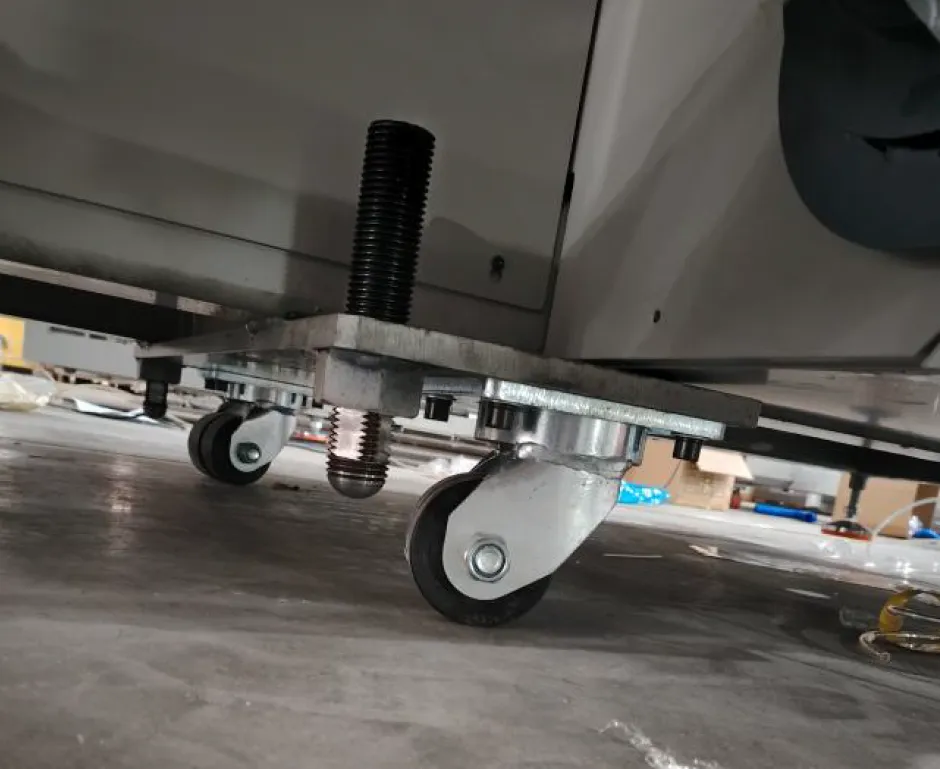
Dividing the total weight by four would not adequately describe this application. The uneven center of gravity may place more load on two mounting positions. Floor joints generate shock, while towing introduces speed, heat and lateral force. The swivel casters must not only carry the load but also rotate under it without excessive steering resistance.
An extra heavy duty caster is more likely to be appropriate because the project may require:
- A higher verified dynamic rating
- A stronger mounting plate and fork
- A larger or specialized swivel bearing system
- A wide or dual-wheel arrangement
- A wheel material selected for both floor protection and towing
- Directional locks for controlled straight-line movement
- A reinforced equipment mounting structure
Even then, the words “extra heavy duty” are not a complete specification. The product must be selected from the actual application data.
Information to Provide Before Requesting a Caster Recommendation
To determine whether heavy duty or extra heavy duty casters are appropriate, prepare the following information:
- Equipment dead weight: The weight of the empty machine, platform or cart.
- Maximum payload: The heaviest material or component carried during normal use.
- Total loaded weight: Equipment, payload and permanently installed accessories combined.
- Number of casters: Include the intended swivel and rigid arrangement.
- Load distribution: Identify an offset center of gravity or changing load position.
- Movement method: Manual pushing, powered towing, AGV/AMR operation or occasional repositioning.
- Maximum speed: Include normal and possible peak speed.
- Travel distance and frequency: Short occasional moves and continuous multi-shift use require different reviews.
- Floor surface: Smooth concrete, epoxy, asphalt, steel plate or another surface.
- Obstacles: Joints, thresholds, gaps, dock plates, rails or debris.
- Environment: Indoor/outdoor exposure, water, oil, chemicals, dust and metal chips.
- Temperature: Normal, minimum and maximum operating temperature.
- Dimensional limits: Wheel diameter, overall caster height and available swivel clearance.
- Mounting details: Top-plate dimensions, bolt-hole pattern and equipment-frame construction.
- Control requirements: Wheel brake, total lock, directional lock or a combination.
Providing this information is far more useful than asking only, “How much weight can this caster hold?” It enables the manufacturer to consider capacity, maneuverability, environment, service life and installation as one system.
How BigCaster Supports Heavy and Extra Heavy Duty Projects
BigCaster manufactures heavy duty and extra heavy duty caster wheels for industrial equipment manufacturers, distributors and project-based buyers. Our product direction includes polyurethane, rubber, PA and MC nylon, cast iron and steel wheel configurations for industrial carts, machinery, logistics systems, container handling, construction and other high-load applications.
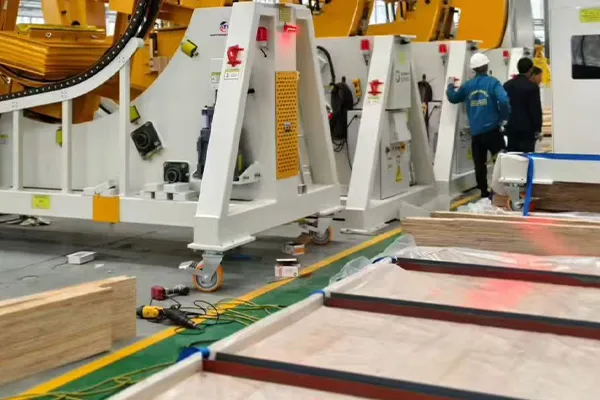
We can review standard and customized requirements, including load capacity, mounting dimensions, wheel material, swivel or rigid configurations, brakes and directional locks. Load-capacity requirements refer to each caster assembly unless a project specification states otherwise.
To receive a more useful recommendation, send us the total loaded weight, number of casters, movement method, maximum speed, floor condition, required wheel size and mounting dimensions. BigCaster can then help determine whether a heavy duty caster or an extra heavy duty caster configuration is the more appropriate starting point.
Frequently Asked Questions
Extra heavy duty casters normally represent a manufacturer’s higher-capacity and more severe-service class. Compared with heavy duty casters in the same range, they may use larger or thicker caster rigs, stronger swivel sections, larger axles, wider or dual wheels and bearing systems intended for higher concentrated loads. The exact distinction varies by manufacturer.
There is no universal capacity threshold. Some manufacturers classify a certain load as extra heavy duty while others include the same capacity within a broader heavy duty range. Always compare the individual caster rating, test conditions, operating speed, duty cycle and application—not only the category name.
No. They can provide valuable capacity and structural reserve, but they may also cost more, increase installation height, require more mounting space or create greater swivel resistance. A correctly selected heavy duty caster is often the better choice for controlled industrial applications.
They can in some applications, depending on the capacity per caster, number of effective supporting casters, load distribution, floor, speed and duty cycle. The equipment’s total weight should not be divided by the installed caster count without considering uneven support and dynamic forces.
No. Extra heavy duty casters are available in both single- and dual-wheel designs. Dual wheels can increase capacity in a limited mounting height and may improve swiveling compared with one extremely wide wheel, but the correct arrangement depends on the axle, bearings, caster rig, floor and required maneuverability.
There is no single best material. Iron-core polyurethane can balance load capacity and floor protection; MC nylon can offer low rolling resistance and strong industrial performance; cast iron and steel can suit concentrated loads or harsh conditions. Floor strength, noise, impact, temperature and chemical exposure must also be considered.
Some can, but the manufacturer must confirm the allowable speed, duty cycle, wheel material, bearing system and load derating. A caster’s ordinary dynamic rating should not automatically be assumed to cover continuous or higher-speed towing.
Conclusion
The difference between heavy duty and extra heavy duty casters cannot be reduced to one universal weight limit. Within a manufacturer’s range, extra heavy duty models generally provide higher capacity and more substantial construction for concentrated loads, shock, repeated movement or severe operating conditions. Heavy duty casters often remain the more efficient choice for controlled industrial applications where their verified capacity and construction are sufficient.
Start with the total loaded weight, but do not stop there. Review load distribution, effective supporting caster count, floor, obstacles, speed, duty cycle, wheel material, swivel performance and mounting strength. If the project involves multi-ton equipment or uncertain operating conditions, explore BigCaster’s extra heavy duty casters and submit the complete application details for a configuration review and quotation.